Transcript
Michael Dargie (00:01.346)
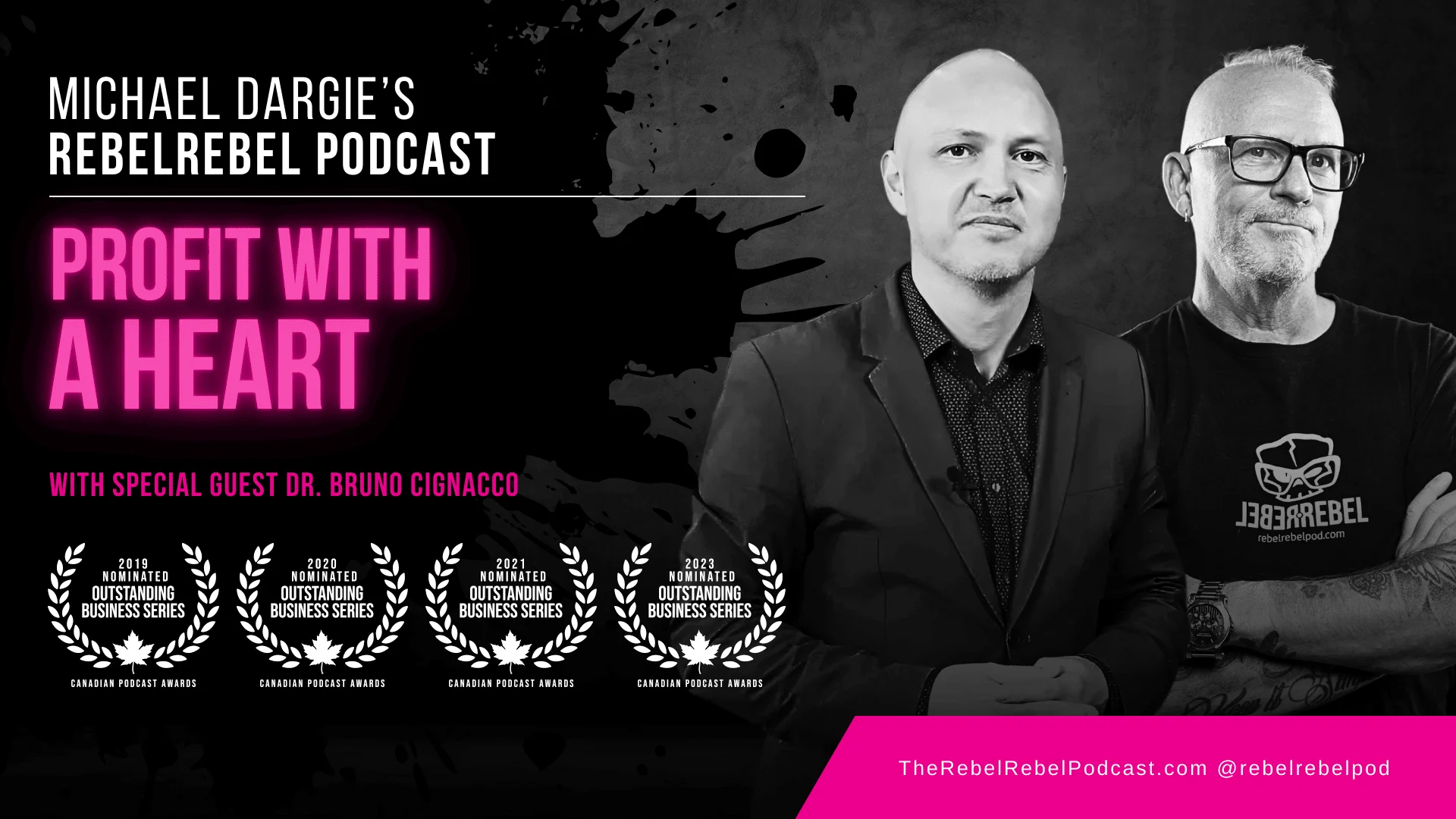
Welcome to the Rebel Rebel. I'm your host, Michael Darghi, and somewhere around the world, we're going to find out where. Please welcome to the show, Dr. Signeko. Dr. Bruno, how are you?
Dr. Bruno Roque Cignacco (00:11.355)
Thank you very much. Very good. Thank you, Michael. Thank you very much for the invite. I feel very honored to be here. Thank you.
Michael Dargie (00:18.514)
thank you. So shall I call you Dr. Throut or Bruno? OK. OK. So Bruno, so I see it on the if you're watching this video, you see on the shelf there, there is the Art of Compassionate Business, which is a book that you wrote before we get into this section, though, I'd really like to know, where are you in the world?
Dr. Bruno Roque Cignacco (00:23.247)
You can call me Bruno, this is more simple.
Dr. Bruno Roque Cignacco (00:43.131)
Well, I'm based on the outskirts of London. This is a small town called Wadford, and it's very close to London, 20 minutes from London, UK. So this is my place in the world. I have been here for more than 17 years, and I feel like I'm another English person.
Michael Dargie (01:01.582)
Very nice. That's so cool. so guess, catch us up. What is it that you're up to right now in London? Like, what do you do on the day to day?
Dr. Bruno Roque Cignacco (01:11.621)
Well, I do many things. Especially I'm a university professor. I'm teaching at different universities here in London, especially at master degrees and any post-graduate course. But also I have been doing this for more than 30 years, not only here in the UK, but also worldwide. But also I'm a researcher and I have been researching on different business topics. As you mentioned, my latest business book is titled The Art of Compassionate Business, but also I'm doing a heavy consultancy company.
that we're delivering advice and consultancy services on international marketing, import-export activities, international marketing strategy. But also lately we introduced a new business unit that is training companies on how to become much more profitable and at the same time more compassionate. This means more human oriented. And this is very successful because many companies feel intrigued about this compatibility between
Michael Dargie (01:58.606)
Dr. Bruno Roque Cignacco (02:10.501)
profitability and human orientation.
Michael Dargie (02:14.388)
I'd say it's so important. What's got you started in this work?
Dr. Bruno Roque Cignacco (02:19.877)
Well, with the latest business unit on compassionate business, we started around five, six years ago, but on international marketing, we have been doing this for more than 30 years. So we have a lot of experience on this area, but I feel that it's a very traditional area. And I feel that in the current times, companies to expand their view of business is very limited, only focusing on profit or closing deals or getting new customers.
without taking into account the human side of business, which implies building long lasting relationships with different stakeholders in a mutually beneficial way. This is a much broader view of business. And I see a new generation of companies that are catching up with this trend of a human orientation, of caring for people and putting people first, not putting profit first. Because when you put people first, profit will follow.
If you do the other way around, you put profit first, you are more likely to pursue this profit by your means, like manipulating customers, polluting the environment, exploiting employees, and so on.
Michael Dargie (03:23.468)
Right.
Michael Dargie (03:29.198)
And I guess the question is like why why you why did you get so interested in this? mean besides the fact that you're a human
Dr. Bruno Roque Cignacco (03:37.359)
Yes, we all have in common the common human. So this is common humanity. I was intrigued when I read an article a while ago, a few years ago, that was titled The Human Moment, The Human Moment at Work that was published in Harvard Business Review. And I read a lot of articles about business topic, but this article was very special because they were not talking about strategies. They were not talking about tactics.
They were not talking about business model, but they were talking about building long lasting relationship with stakeholders. Developing these moments where people can connect on an emotional level, on a mental level, and they can build some rapport, they can understand each other, they can know each other on a much more personal level, beyond their work positions, their work activities.
And this was touching me, touching my heart because I said to myself, this is a topic that is such an important topic and I haven't seen many books written on this topic. I see a lot of book about strategy. I see a lot of book about traditional leadership, management. But this was intriguing me and I started the process of researching and I noticed there is a lot of science-based studies on compassion and business.
lot of science-based study on the importance of generosity in business, on the importance of gratitude in business, on the importance of forgiveness in business. And I said to myself, this is very interesting because these are non-traditional topic, but they are so important because the building brick of any business activity is not artificial intelligence, is not technology, is not information, is not money, but is the human being, the common factor of all business activities, the human being.
Michael Dargie (05:30.188)
you
Dr. Bruno Roque Cignacco (05:31.121)
And it's a meta resource. It's a resource that generates multiple resources. Generate business model, new products, new services. So I failed the trick and this was coronated, this research process was coronated by my first book on this topic that was the Art of Compassion and Visit before COVID 2019. And then I discussed with the publisher after COVID if we can expand this vision to a much
Michael Dargie (05:37.538)
Yeah.
Dr. Bruno Roque Cignacco (06:00.109)
a much broader, much more overarching edition, and this was published in 2023. The second edition includes hundreds of cases of compassionate organization and also lot of research studies on compassionate leadership, for example, generosity in business, gratitude in business, and so on.
Michael Dargie (06:14.798)
Hmm.
Michael Dargie (06:19.798)
Wow. Well, that is it's worth doing. And it's so good to hear somebody's out there fighting for the humans. Some of the I do talks fairly regularly. And people are always asking, you know, is it important to be B2B or B2C or D2C or, you know, B2J, whatever. And I said,
The most important thing is to do P2P. It's person to person, no matter what happens. If it's business to business, it's still people that are working together to do stuff.
Dr. Bruno Roque Cignacco (06:49.425)
So, thank
Dr. Bruno Roque Cignacco (06:55.045)
there is research that back this assertion that is, for example, let's imagine two companies offering exactly the same product with different brands, but more or less the same product, the same design or similar design, similar quality, similar price. If you put two customers in front of these two companies and they are exactly the same, they cannot differentiate based on the product. Customers are more likely to become loyal to the company that personalize their approach, that customize their approach, that offers something that is
unique for this customer and might not be suitable for other customers. This means that this company is a product customer, not in an impersonal way, but in a very personalized way, humanizing customers, not considering customers as a number in the database that will contribute to the company's profit. But understanding that customers have needs, not only economic needs, but emotional needs, mental needs, and need for information that needs to be provided by this company.
Michael Dargie (07:35.692)
Yeah.
Dr. Bruno Roque Cignacco (07:53.457)
And when the company understands that each customer is unique, this company is more likely to offer product that is suitable for this customer. And if the company doesn't count on this product, can recommend this customer another company that they should go and resort to to look for this product. And this customer is more prone to become loyal. And this become a repeat customer. means that we'll come back to the company and also we'll recommend this product to other customers. It will become a
Michael Dargie (08:13.634)
friend.
Dr. Bruno Roque Cignacco (08:22.681)
a very old but unpaid ambassador for this company.
Michael Dargie (08:26.286)
Outstanding. What is your, the work that you do, what's your favorite part? Like what's the thing that gets you
Dr. Bruno Roque Cignacco (08:33.361)
My favorite part is, I have to say, when I see companies that are resisting the concept of compassionate business, they are a bit resistant because in practice, they have been using the traditional model. They believe that everything is about a key performance indicator, profitability, productivity. We have to be hard with employees. We have to micromanage. And when I show them the research,
through training or through consultancy activities that show them the research. You know what? If you micromanage people, for example, they're more prone to become disengaged. Why? Because you're treating them like naughty children. Like they cannot be relied on. You cannot trust them. You do not take into account their need for autonomy, for competence. So they need to be treated as other people. And when I show the research,
the important research on autonomy in the workplace and the importance of delegation in the workplace. This company understands, oh, okay, this means that in some cases they tell me, oh, they have other needs beyond having a good salary. Of course, because employees don't have only the need for a good salary. They need to be recognized, they need to be appreciated, they need to be supported, they need to be, in some cases, trained or mentor or coach.
is a big discovery. When I see that the coin drops and I see the insight that is gained by this company, give me a lot of satisfaction because at the end, I'm very content of having published the book, but I want to design and these ideas as much as possible all over the world until the end of my days because it's so important and there are so many companies that are stuck with the traditional business model, not putting people first, but being
Michael Dargie (10:15.534)
Yeah.
Dr. Bruno Roque Cignacco (10:24.721)
harsh with people that is the opposite that should do because at the end if you are harsh, what do you expect them to cooperate? What do you expect them to do to be willing to provide new ideas, innovative insight? No, they will withdraw. will work by the book. Customer will run away from this company. So being harsh doesn't work, not even for achieving key performance indicators. Being a good at building relationship with different stakeholders.
Michael Dargie (10:44.514)
Yeah.
Dr. Bruno Roque Cignacco (10:54.415)
bring about higher key performance indicators, better quality levels, more productivity and so on. I can mention some studies later on that corroborate this fact that being good with people, being attentive, kind, compassionate, grateful, generous, also there is a lot of research on generosity, you are more prone to build non-lasting relationships where people tend to reciprocate. You treat them well and they treat you in return in the same way.
Michael Dargie (11:21.122)
you
Outstanding. What is, I'm going to put you on the spot. What's one of your favorite businesses that you think is doing it right?
Dr. Bruno Roque Cignacco (11:32.197)
Bye.
Well, there are many companies that I mentioned in the book, but I feel that a very interesting exemplar is Patagonia. Patagonia, that I mentioned many times in the book, that is an entire company, is a company that imagine. They have a metaphor that they use on their website that they said that their shareholder is the planet. Their shareholder is the planet. So this means
What do they mean by this? That every single activity that the company performs, this company performs, is to support the planet, to be environmentally friendly, to devote part of their profit to improve the environment and also avoid all these environmental disasters that we see now. And this company apply this on a practical level. For example, for the attire they use organic cotton. Most of the cotton that they use is organic. This means that
this cotton would have used pesticides or chemicals that pollute the environment. And also they're bad for people when they're using their adult. But let's have a look at this example. This company has a childcare facility on site. When employees go to work, they can take their children. This is included in the salary pack. So when they take their children, children are taken care in this nursery site by special
Michael Dargie (12:38.063)
Right.
Dr. Bruno Roque Cignacco (13:02.853)
the professionals and then they can see their children when they have a break during meeting. Isn't that wonderful? And employees are not charged for this. So this is a very difficult to beat company because they are caring for employees and they are caring for employees in a very wholehearted way. They are not speculating, this will cost us more. No, because they know when the employees are feeling well, they are more likely to become innovative, creative, cooperative.
Michael Dargie (13:21.965)
Love it.
Dr. Bruno Roque Cignacco (13:31.929)
And I want to mention a study that corroborates what this company is doing on a scientific level. There is an interesting study that observed that company that developed a compassionate workplace, this author called this loving workplace, a compassionate workplace where employees feel supported, where employees feel taken care of, when employees are allowed to give their views also, they're not censored, when employees are cooperating with each other.
When employees have a problem, can be assisted by managers or other people working for this company. What we call a psychologically safe workplace. In this workplace, there tend to be higher employee satisfaction, higher customer satisfaction. Why? Because employees that feel well can serve customers much more wholeheartedly, but also lower absenteeism, lower stress level, which implies lower medical bills, and more productivity, more cooperation.
and this impact positively on the bottom line. So this means that you care for employees that are the interface between the company and the external environment, and this employee will take care of the company. I will help you achieve this key performance indicator. So this means that the achievement of key performance indicator is always indirect. You care for people that you are interdependent with, and these people will help you achieve this key performance indicator. So this means that you cannot buy spice people. So when you care for people,
customers, employees, community members, suppliers, business partners, these people will help you achieve this key performance indicator. If you don't care for them, these people will hinder the process of achievement of key performance indicator. Why? Because customers will withdraw, employees will leave the company. Well, the community member might boycott the company because they don't like how the company is acting. So caring for people is the best investment that the company can
Michael Dargie (15:22.903)
Love it. What is something that you like to do with somebody else?
Dr. Bruno Roque Cignacco (15:27.811)
In which level? business?
Michael Dargie (15:30.093)
No, I think just in life. Like just...
Dr. Bruno Roque Cignacco (15:31.993)
In life, I like to talk to people. I like to talk to different people and I'm open to other views because I like diversity and I like to learn from other cultures. And because I'm a specialist in international marketing, I always like to travel on holiday or because of business purposes. And I like to find out the special dishes or the typical customs in this cultural environment. And I like to imagine how will I act.
Michael Dargie (15:57.315)
Nice.
Dr. Bruno Roque Cignacco (16:01.475)
if I was born in that cultural environment, what is a very important concept that we call in marketing, cultural sensitivity. I don't try to impose my view, but I'm very respectful of other cultures views. And I try to imagine how this will be seeing the world from the cultural lens that they have. And this is very important because the cultural diversity, there is also a lot of studies on this that
Michael Dargie (16:09.775)
Mm-hmm.
Dr. Bruno Roque Cignacco (16:29.175)
In the workplace, when there is cultural diversity, this workplace, people in the workplace tend to be more creative. Why? Because they are continually immersed within different views, different perspectives. So it's not homogeneous, different views of the world. And in some cases, these views of the world complement each other.
Michael Dargie (16:49.045)
Love it. How important do you think it is for people to get out and travel to see the world?
Dr. Bruno Roque Cignacco (16:53.445)
Very important, very important. It's a learning process. And I believe I have in the book, I have two chapter about learning and what I call prosperity mindset. Getting in contact with the world is another way of learning. And learning is not only learning in a formal way, for example, from a book or for example, from a podcast or from a course or from a degree or a business program, but people can learn from a conversation.
with a stranger or can learn, for example, the CEO can learn from a talk that they got with a janitor working for this company. So this means that learning is very diverse and it's multi-dimensional. This implies that you can learn from different sources and you can learn from visiting another country and thinking about, this idea look good for the perspective, from the business perspective, and maybe I can adopt this idea.
and introduce this in my home country and maybe or maybe we can modify this idea and we can adapt this to our cultural environment. You can always learn from the business perspective, from the personal perspective. And what you find when you travel a lot, I used to travel a lot and also I travel quite a lot now too. is that regardless of the culture, we have a common humanity. This implies that we have.
in common and this applies to business too. We have bad experiences, have positive experiences, have dreams, aspirations, and when you focus on others based on this common humanity, you are more likely to avoid polarization, avoid conflict. Why? Because you connect to a much more hard level, a much more emotional, not only mental level, but emotional mental level, which implies that you know the human being. What I observed in business,
this type of connection is very rare. Why? Because people are only connecting to each other on the level of their positions, on the level of, for example, the hierarchy within the company. I am the manager, you are the subordinate. And this cannot create cooperation. Why? Because when there is a symmetry, it means that one has more power than the other one. You don't connect on similarities, on commonalities. And there is a lot of research in psychology that observe that when you focus on
Dr. Bruno Roque Cignacco (19:19.045)
Commonalities, for example, you are the customer service officer and you are connecting to a customer, but they are both human with worries, with expectation, with dreams, with family, health issues, in many cases. When you connect on a much more human level, you are more prone to create more rapport. The communication is more meaningful. You are more prone to discuss important ideas on a personal level, on a business level, and the relation tend to be strengthened, brightened over time.
It says when you limit only to a business level, there is a full chapter on conversation, what I call natural conversation. When you focus only on business level means talking about budget, strategy, tactics. Many people feel like they are treated as a means to an end. I'm talking to you because you will help me achieve this objective, but I don't care for you as a human being. You are only a means to achieve an end, a goal.
and I need you, but I need you in a utilitarian manner, not on a human level. And people don't like this because in many cases they feel manipulated. And what I suggest in the book is to include not only business conversation, but maybe before any business meeting, five minutes personal conversation. means, how was your weekend? Or how was your family? And many companies go one step further. They celebrate the humanness of their workplace.
by having one meeting a week for social purposes. They go have a dinner together where there is no hierarchy. People can connect to one another on a personal level. The CEO doesn't exert any power there because we talk to others from equal to equal. This means we're all in this meeting together to know each other beyond our position. And when people come back from this meeting, there is a lot of research on this.
tend to be much more revitalized. The communication in the workplace tend to be more insightful, more meaningful because they know beyond their role. The role is a very tiny part of the human being. Before getting the role, they were already human beings. And some people believe that they're only their role, what is very strange and very limiting. So we have people beyond the role. And they always advise companies to bring about these opportunities.
Michael Dargie (21:21.177)
Yeah.
Michael Dargie (21:33.012)
Yeah.
Dr. Bruno Roque Cignacco (21:46.149)
maybe social events, not only once a year for Christmas or a special event anniversary, the company anniversary. No, this should be at least once a month minimum so that the employee can know each other and they'll tend to become much more competitive in some cases they develop friendship ties which will help them to be more productive, creative and competitive in the workplace.
Michael Dargie (22:07.523)
I love it. What's one place you haven't been to that you desperately want to go to?
Dr. Bruno Roque Cignacco (22:12.633)
I want to go to Egypt. I haven't been to Egypt and I want to go next year. But hopefully I will have time to go. This is something that I don't want to do in a superficial way. I want to do in a very deep way, at least two weeks, because I am very intrigued about this culture. a lot. I delivered a talk for a university in Egypt, Heliopolis University, but this was online. And I am very intrigued to...
go there, the culture, the pyramids and so on. And this gave me very excited, but I have to plan for maybe for next year, I will have the time to, I have to set two weeks that in some cases could be challenging.
Michael Dargie (22:44.131)
Yeah.
Michael Dargie (22:52.992)
That's really cool. yeah. So what is something you do for you that fills your bucket? Like what gets you recharged?
Dr. Bruno Roque Cignacco (23:01.553)
Well, some people will consider this a bit more. I like to read a lot. I read many books a week and I think that books are bridges to new knowledge. And I believe that a very renowned leader like Warren Buffett or Bill Gates, I read a lot of books a year, are very wise with this approach because these people already have all the power, already have all the achievements. They don't need to read more.
but they are continually learning. And I believe in their philosophy that we are learning beings, we have an ongoing learning attitude until the end of our days. And this implies that when I read and I find something that I don't know, this made me more humble because humbleness is a very important quality that most people don't have. me more humble and say, you know what, this is so genius and this is such an interesting approach.
Michael Dargie (23:56.611)
Hahaha
Dr. Bruno Roque Cignacco (23:58.467)
How would I have thought about this? I wish that I would have been the one discovering this. And this made me so humble, but also made me enrich my view of the world because reading, and many people will consider reading a big volume, but it's so important. And many readers are leaders. And many readers are leaders. And many leaders are readers. So it's very important.
Michael Dargie (24:21.137)
I love it. What's your favorite? Who's your favorite superhero?
Dr. Bruno Roque Cignacco (24:28.421)
the super hero, well, I used to like when I was a child, Spiderman. Spiderman I like because it was climbing the buildings and so on and also the spider web. I love it, I love it. And I also like a lot Batman. I like a lot Batman in a way that the Batman car, this is a toy that nobody bought to me when I was a child. made with a...
Michael Dargie (24:42.607)
you
Mm.
Dr. Bruno Roque Cignacco (24:55.567)
have a grudge over this fact that I couldn't get when I was a child but I love this and I love the old passion Batman series that were very nice. Yes these were the two superheroes I would say that they are unique in their own skill their own power and I feel that they are good example of a good superhero.
Michael Dargie (25:07.897)
Yeah.
Michael Dargie (25:20.195)
That's awesome. I don't think I've ever asked that question to anybody before. don't know why, but I just needed to know. Coffee or tea?
Dr. Bruno Roque Cignacco (25:27.14)
It's okay.
Dr. Bruno Roque Cignacco (25:34.261)
definitely. I'm half Italian, I'm Italian-Argentinian, but you give me the choice. I like cappuccino, in some cases I like to drink cappuccino, decaffeinated or maybe caffeinated, but it's my preference because I have much more variety of tea and I have chamomile tea at home. Green tea cannot be, I cannot run out of
green tea because it's so important and it's also very healthy. Yes, all type of tea and fruit tea I like too. Preferably also I like decaffeinated tea because most tea has caffeine but I like to also get a bit healthy and I'm drinking less caffeine now because I want to be much calmer but yes. Tea, tea definitely and also here in England tea is the preference. Most people will choose tea. You have a lot of tea shops and tea.
Michael Dargie (26:26.592)
Yeah.
Dr. Bruno Roque Cignacco (26:31.086)
little bars where you can get special t-tees.
Michael Dargie (26:34.573)
love it. Pardon me, there are these people in the world. Dr. Bruno, we call them rebels and waiting. And these rebels, imagine if you will, somebody is about to do a thing that they've never done before, or they decided to do something completely different than maybe what their friends are doing, or, you know, it's outside of their comfort zone. So they want to rebel against the norm, the status quo.
Dr. Bruno Roque Cignacco (26:51.983)
Okay.
Michael Dargie (27:03.404)
and they're about to do it or maybe they've just started to do it, what advice do you have for them to help them, you know, get their rebel on to do something different?
Dr. Bruno Roque Cignacco (27:13.871)
Yes, well, this is an idea that I mentioned also in the book. It's all about immersion. Immersion. At the beginning, you might be fearful. At the beginning, I remember when I started teaching 30 years ago, I was trembling, I was shaking. I was very fearful. said, what I will do there, the first few sessions. And then it's a matter of immersion. At the beginning, all learning process could be a bit painful. Some people have to bear the pain. In some cases, it could be intense.
But if you do gradually, this means that you introduce small challenges and then much bigger challenges and then bigger and bigger, you will overcome the fear because at the end, the most important obstacle in any business or personal endeavor is fear. The most important obstacle is you. So you have to get out of the way. And in some cases, fear can be so intense that it looks real. But remember the concept, immersion, gradual connection to the...
activities that related to the project that you want to undertake. means that supposing that you want to start up a company and you don't know how to do. Well, maybe the first connection point will be, okay, let's find out, for example, if there is any business association that can provide me with advice or list, recent example about a successful startup, what they are doing, or list talking business advice, small step, what I call also, and many other call small wins. This means that you are
connecting gradually. You won't probably look from the start for investors if you haven't had any experience. Maybe you go with smaller steps, gathering information and then drawing some business models or business plans and then talking to other people and then for example going and talking to people for example in an entrepreneurial association or a chamber of commerce that can provide you with some advice or talk to an accountant or a lawyer that can give you some
a country or legal advice. So the very gradual connection doesn't mean slow, but gradual so that you are gaining confidence. And when you're gaining confidence, because you're getting immersed gradually, like getting into the swimming pool. If you don't know how to swim, it's unlikely that you get into the deep part. You get into the shallow part very slowly. And then when you're feeling comfortable, say, I could do this. And you get more confidence. And from the scientific perspective, this confidence is called self-efficacy, meaning that you feel
Michael Dargie (29:15.075)
Mm-hmm.
Dr. Bruno Roque Cignacco (29:38.961)
You feel that you can do it. You have a feeling of, can. I could do this small, well maybe I can do something bigger. This is because you are the worst obstacle in any endeavor. No doubt about this. This applies to all people.
Michael Dargie (29:50.031)
you
That's fantastic advice. Thank you so much for that. Dr. Bruno, where can people learn more about you?
Dr. Bruno Roque Cignacco (30:01.617)
Well, if they want to know more about my new book, they can find my new book, Art of Compassionate Business. White Cover, this is the second edition, more than 450 pages, they can find this book worldwide. Online shops, Amazon and any other, and offline shops, book shops, they can be found worldwide. And this is followed by release, the second edition, 2023. They can find me also on my website, www.brunosignaco.com.
And they can find me on LinkedIn. I'm continually posting articles and continually posting interviews, some interesting interviews published in interesting publications, and also some cases of companies that are adopting a compassion attitude towards stakeholders.
Michael Dargie (30:47.659)
love it. We'll put everything down in the show notes. Bruno, this has been a real treat for me. Thank you so much for joining us on the show.
Dr. Bruno Roque Cignacco (30:53.957)
Thank you very much. Thank you, Michael.
Michael Dargie (30:58.073)
Just like that, my friend.
Dr. Bruno Roque Cignacco (30:59.665)
I the personal question too. They have a nice touch. Thank you for asking about Egypt. This is a priority for next year. I need to go. I have been to a strange place but I haven't been to Egypt. This is something that is on my list and hopefully I will have time. Have you been to Egypt?
Michael Dargie (31:01.517)
Yeah, so good! So good!
Michael Dargie (31:08.559)
Thank you.
Michael Dargie (31:23.341)
I know. I haven't. But it's on the list. I have a growing list of places I have to see. Part of me wishes I lived in Europe because everything is so close in Europe. In Canada, you've got Canada, which is huge, and the United States, which I'm not traveling to at the moment. But there's so many places to see in the world.
Dr. Bruno Roque Cignacco (31:53.307)
Thank you for the question.
Michael Dargie (31:55.513)
Thank you. I'm just going to hit stop on the recording here.