Bruno Cignacco on Why Putting People First Is the Best Business Strategy

There's a moment in most business conversations where someone says something obvious. Something you've heard so many times it's stopped meaning anything. "Put the customer first." "People are your greatest asset." Standard stuff. Fridge magnet philosophy.
Then Bruno Cignacco opens his mouth, and somehow it doesn't sound like that at all.
Dr. Bruno Roque Cignacco is a university professor based just outside London, an international marketing consultant with thirty-plus years in the field, and the author of The Art of Compassionate Business. He's calm, precise, a little formal in that way that people who've spent decades in academia sometimes are. But underneath the measured delivery, there's a genuine fire. He actually believes this stuff. And the more he talks, the more you find yourself believing it too.
The Article That Started Everything
Bruno didn't arrive at compassionate business through some personal crisis or career pivot. It started with an article. A piece in Harvard Business Review titled "The Human Moment at Work." He told me he reads a lot of business articles. A lot of business articles. But this one was different.
"They were not talking about strategies. They were not talking about tactics. They were not talking about business models. But they were talking about building long-lasting relationships with stakeholders."
That landed for him. Because most business literature is obsessed with the machinery. The models, the frameworks, the KPIs. Nobody was writing seriously about the fact that the whole enterprise runs on human beings. Bruno started digging into the science, and what he found was a mountain of research on compassion, generosity, gratitude, and forgiveness in business contexts. All sitting there, largely ignored by the mainstream.
He published the first edition of his book in 2019, just before COVID rewrote everyone's understanding of what a workplace actually is. After the pandemic, he and his publisher expanded it significantly. The second edition came out in 2023, runs over 450 pages, and includes hundreds of real-world cases of compassionate organisations doing exactly what the research said they should be doing.
The Actual Argument (And It's Not What You Think)
Here's where Bruno's position gets interesting, and where I think a lot of people in business genuinely misunderstand him. He's not making a moral argument. He's not asking companies to be nice because nice is virtuous. He's making a performance argument. Compassionate businesses perform better. Full stop.
"The achievement of key performance indicators is always indirect. You care for people that you are interdependent with, and these people will help you achieve this."
He put it another way that I keep thinking about. If you put profit first, you're more likely to pursue it by whatever means necessary. Manipulating customers, exploiting employees, cutting corners on your environmental impact. But if you put people first, the profit tends to follow. Because people, it turns out, respond well to being treated like people.
I know. Shocking.
Bruno cited a study on what the researchers called a "loving workplace" (which, yes, sounds a bit much, but stick with it). Companies that built genuinely compassionate environments, where employees felt supported, heard, and psychologically safe, reported higher employee satisfaction, higher customer satisfaction, lower absenteeism, lower stress levels, and more productivity. The whole scorecard improved. Not despite treating people well. Because of it.
Why Micromanagement Is Slowly Killing Your Business
One of Bruno's favourite moments in his consultancy work is the one he calls "when the coin drops." He described it for me with real satisfaction. He goes into companies that are resistant. They're running the traditional playbook: hard metrics, tight control, productivity as the only measure of worth. And they're proud of it. That's how you get results, right?
Then he shows them the research on micromanagement. What it actually does to people. "If you micromanage people, they are more prone to become disengaged. Why? Because you are treating them like naughty children."
You're communicating, in every interaction, that you don't trust them. That their autonomy doesn't matter. That they are bodies filling roles, not people making decisions. And the research is unambiguous about what happens next: those people stop innovating, stop going beyond the minimum, stop caring. They work "by the book," as Bruno put it. And the customers feel it.
The coin drops when these companies realise that employees have needs beyond a good salary. Recognition. Appreciation. Support. The chance to grow. (Bruno mentioned mentoring and coaching specifically, which tracks with pretty much every conversation I've had with great leaders on this show.) When those needs get met, the whole system starts working better. It's not charity. It's leverage.
P2P: The Only Business Model That Matters
I brought up something I say in my own talks, which is that everyone wants to know if they should be B2B or B2C or D2C or whatever alphabet soup is trending. My answer is always the same: do P2P. Person to person. Because no matter the business model, it's still humans working with humans to make things happen.
Bruno ran with that and backed it up with research. He described a scenario where two companies offer essentially the same product at essentially the same price. Same quality, similar design. On paper, indistinguishable. The customer will still become loyal to the one that personalises their approach. The one that treats them as an individual with specific needs, not a number in a database contributing to quarterly revenue.
And here's the part I loved: he said that if a company genuinely doesn't have what the customer needs, the truly compassionate thing is to recommend someone who does. Even a competitor. Because that honest act is what converts a customer into what Bruno called "a very old but unpaid ambassador." Someone who talks about you, recommends you, brings people to you. Not because you sold them something. Because you were actually honest with them when you didn't have to be.
Patagonia and the Shareholder Nobody Expected
When I asked Bruno to name a company doing it right, he didn't hesitate. Patagonia. He mentioned them multiple times in the book and came back to them in our conversation with a kind of admiration that felt personal.
The detail he kept returning to was their childcare facility. Employees can bring their children to work. The kids are cared for on-site by professionals. Parents can see their children during breaks. And it costs the employees nothing. It's part of the package.
"They are caring for employees in a very wholehearted way. They are not speculating, 'this will cost us more.'"
But the thing that struck me most was how Patagonia describes their own purpose. They say their shareholder is the planet. Not investors. Not quarterly earnings. The planet. Every decision the company makes flows from that. The organic cotton. The environmental initiatives. The on-site childcare, which reduces commuting stress and keeps families connected. It all comes from the same source: a genuine commitment to something bigger than the bottom line.
And yet. They're a wildly successful company. Because people want to buy from them. People want to work for them. The compassion is not the cost of doing business. It is the business.
Natural Conversation as a Business Practice
One of the more practical ideas Bruno raised was something he calls "natural conversation," which gets its own chapter in the book. The argument is simple: most business interactions strip out everything human. You talk about budgets, strategies, deliverables. Nobody asks how your weekend was. Nobody mentions their kids.
And what that communicates, underneath the professionalism, is that you're a means to an end. That the relationship only exists because you're useful.
Bruno's suggestion is disarmingly simple. Before any business meeting, spend five minutes talking about something personal. How was your weekend? How's the family? He mentioned companies that go further, holding regular social events where hierarchy doesn't apply. No titles. No power dynamics. Just people getting to know each other as human beings. And the research shows that when people come back from those events, communication in the workplace becomes more meaningful. More creative. More productive.
"The role is a very tiny part of the human being. Before getting the role, they were already human beings."
That line stopped me a bit. Because we've all been in places where that wasn't the operating assumption. Where your value was precisely equal to your job title and nothing else.
The Rebel Case for Immersion
Near the end of our conversation, I asked Bruno what he'd say to someone on the edge of doing something different. Someone about to break from the expected path and try something that scared them.
His answer was about immersion. Not throwing yourself in the deep end, but getting into the shallow part of the pool. Taking small steps. Gathering information. Finding one business association, talking to one accountant, writing one page of a business plan. Building confidence through small wins until the thing that seemed impossible starts to feel manageable.
"The most important obstacle in any business or personal endeavour is fear. The most important obstacle is you. So you have to get out of the way."
He called the resulting confidence "self-efficacy." The science of believing you can do it, built through evidence rather than pep talks. Which, honestly, is more useful than most of the motivational content floating around the internet.
Bruno also talked about reading. A lot of reading. Warren Buffett reads. Bill Gates reads. People who've already achieved everything still prioritise learning, and Bruno thinks that's the point. Not to get smarter, but to stay humble. Because every book that shows you something you didn't know is a reminder of how much is still out there. And humility, he argues, is one of the rarest and most important qualities in business.
(He also told me he grew up wanting a Batman car and nobody ever bought it for him. Some wounds don't heal. I respect that.)
Why This Matters Right Now
I think the reason Bruno's work resonates, and the reason The Art of Compassionate Business has found such a wide audience, is that it names something a lot of people in business already feel but don't have language for. The sense that something is missing in the way most organisations operate. That the relentless focus on efficiency and output is producing workplaces where nobody actually wants to be.
The data backs Bruno up. The science backs him up. And increasingly, the market is backing him up. Companies that genuinely put people first are building the kind of loyalty that advertising can't buy.
It's not soft. It's not idealistic. It's just good strategy that happens to also be the right thing to do.
Which, when you think about it, is the best possible outcome.
Catch the full conversation with Bruno Cignacco on The RebelRebel Podcast, where we also get into cultural sensitivity in international business, his plans to finally get to Egypt, and the deep injustice of never receiving a toy Batman car as a child.
This article is based on
Bruno Cignacco and Profit With A HeartAbout the Author: Michael Dargie
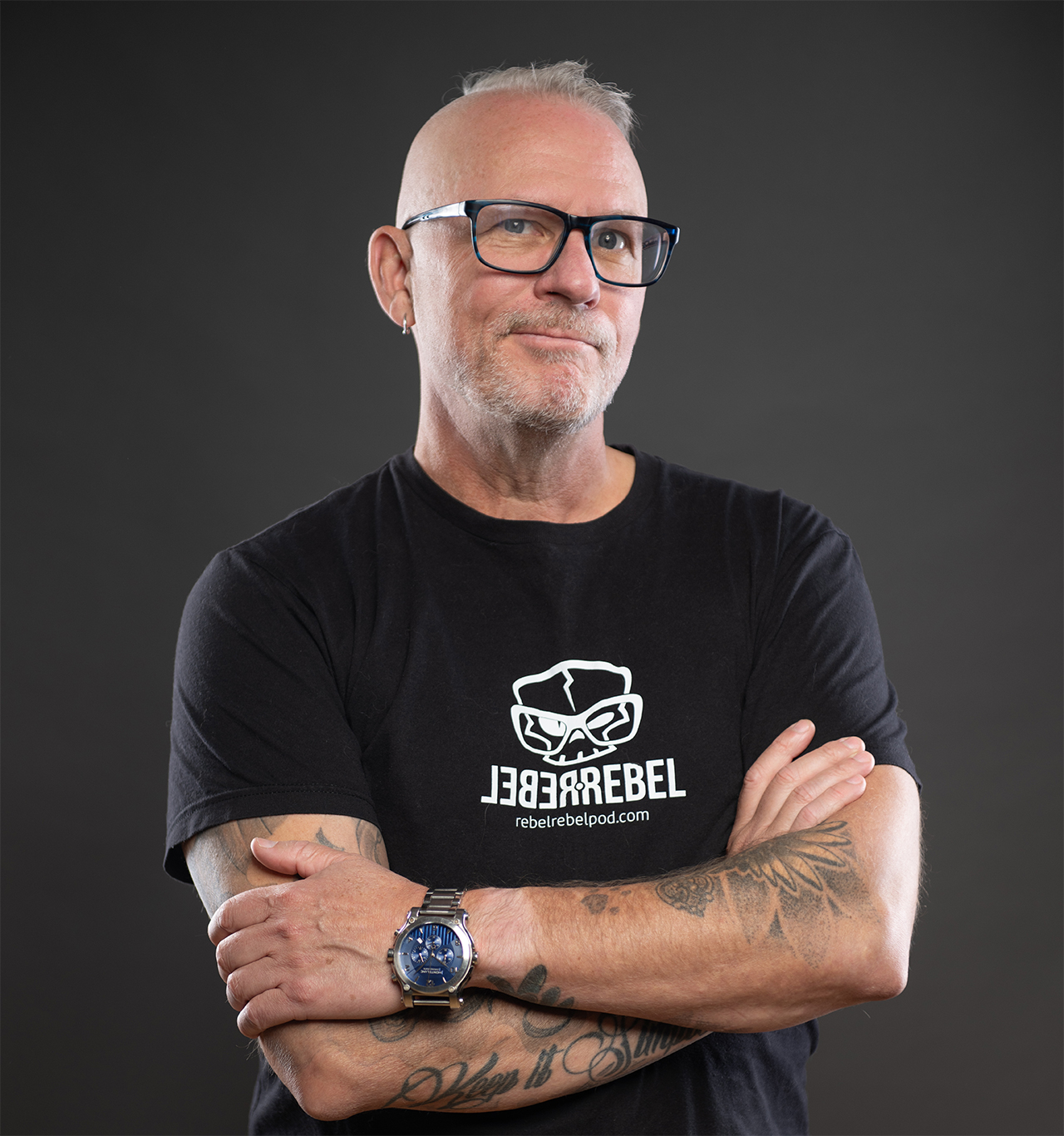
Michael Dargie is a creative strategist, entrepreneur, and the voice behind the RebelRebel Podcast. He founded Make More Creative, a creative agency helping brands stand out in a noisy world, and authored BrandJitsu™: Move Your Brand From 'Meh' To Memorable. A motorcycle rider, scuba diver, octopus whisperer, artist, writer, director, and adventurer — Michael brings a deep curiosity and genuine warmth to every conversation. He believes the best stories come from people who dare to do things differently, and he has spent nine seasons proving it.