Transcript
Michael Dargie (00:01.939)
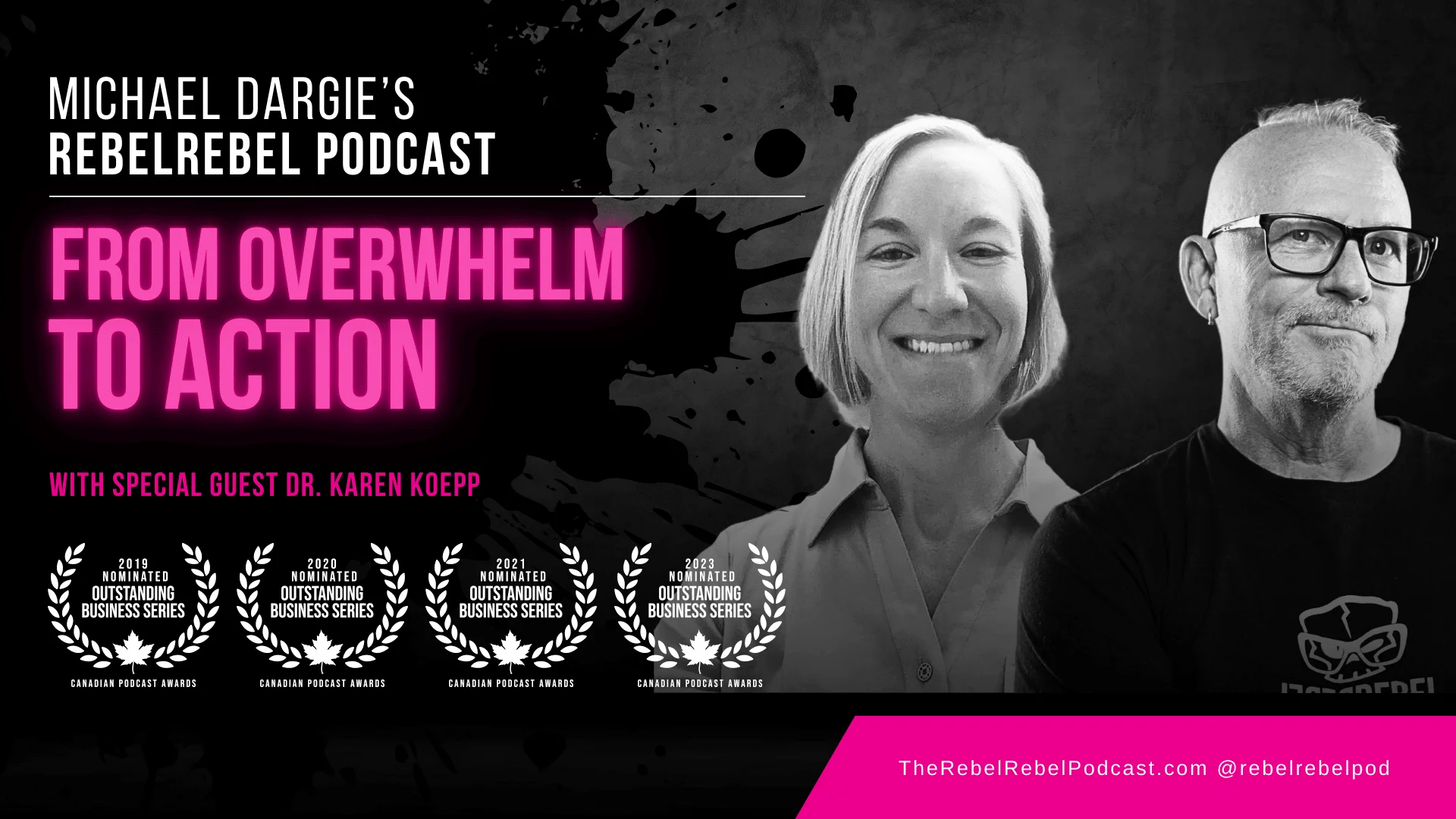
Welcome to the Rebel Rebel. I'm your host, Michael Darghi, and somewhere around the world, we're about to find out exactly where. Please welcome to the show, Dr. Karen Kep. How are you, Karen?
Dr. Karen Koepp (00:12.31)
I'm great. Good to be here.
Michael Dargie (00:14.487)
I'm so glad that you're here! Where are you in the world?
Dr. Karen Koepp (00:17.868)
Well, right now I'm in Utah. I usually split my time between LA and Utah, which kind of sums me up. Strategist, mountain wanderer.
Michael Dargie (00:29.749)
That's beautiful. Yeah, mountains are gorgeous. That's incredible. So you're in Utah, spend your time in LA. What is it that you do? What does Dr. Karen Kep do?
Dr. Karen Koepp (00:41.208)
Well, I am what I call a reinvention and IP strategist. So when individuals get to the end of a chapter or they are at the top of their game and then they hit a bump and that's because of reinvention, like because of AI is transforming everything or a layoff or they sold their business.
I help them figure out what's next and then not only figure out what's next, but actually bring that to fruition.
Michael Dargie (01:18.323)
That's huge. had okay. just out of curiosity, what's like what's your go to figure out what's next move? Like, what's like the one question that you ask that unlocks everything else after?
Dr. Karen Koepp (01:28.846)
Hahaha
Dr. Karen Koepp (01:34.413)
The beautiful thing is that the secrets to what's next is in our history. So it's in those stories of when we've come fully alive, those times when we're in the zone, when we're in the flow, when we're bringing our best skills to bear, and when we feel like we've really made a difference. And it could be a, yeah, it could be a little, small difference. It could be a huge difference.
Michael Dargie (01:39.455)
Yeah.
Michael Dargie (01:58.143)
That's awesome.
Dr. Karen Koepp (02:03.372)
What matters is that it's meaningful to us.
Michael Dargie (02:06.323)
Wow. That hits. That hits. That hits hard. I like it. Thank you. So let me let me ask you this. Have you always been this way? Like, what was young Karen like? Were you just like, I'm going to help people figure their stuff out? Maybe that was five year old Karen or were you like, I want to be a marine biologist.
Dr. Karen Koepp (02:22.412)
Hahaha.
Dr. Karen Koepp (02:29.518)
Well, it was definitely a journey, that's for sure. But like everyone, I can look back and see these stories emerging in myself. So how it all began. How it all began is that like a lot of people, I tried to...
Michael Dargie (02:31.367)
Okay. All right.
Michael Dargie (02:46.107)
Hahaha
Dr. Karen Koepp (02:55.394)
do everything right, get the good grades and get the internships and the scholarships and land my dream job. And I did that out of college. was a management consultant with a big four firm, loved a lot of things about that, but there was something missing and I wasn't sure what and I had no time to figure out what was what because I was traveling constantly. And then I, so I took the leap and
switched jobs, cause I was burned out, but that didn't help. And it just made, yeah, made things worse and, tried other things. Nothing, nothing was happening. And it became this six year journey of doing every self assessment. was volunteering, trying part-time work.
Michael Dargie (03:31.837)
Yeah, I want to talk about that.
Dr. Karen Koepp (03:54.147)
different things, a lot of travel, and that I ended up getting into a master's program. And that brought me to the thesis, the master's thesis. And I was always a strong writer, but the thesis was a different beast. And there was no help to figure out how to do it. And it was just agony for these two years of working through that.
Michael Dargie (04:00.415)
Okay.
Michael Dargie (04:20.405)
I can imagine.
Dr. Karen Koepp (04:24.596)
And it was through that experience that I found like the first step, which was helping people turn their experience into research. And then from there into books and articles and businesses and things like that.
Michael Dargie (04:40.373)
Interesting. Yeah.
Ha ha ha. And when did you like was it a was there like a clarifying moment for you where you're just like this is my purpose. This is what I like was did the heavens open and the light shone down and you're like fully realized, you know. Awesome.
Dr. Karen Koepp (04:47.778)
Yeah.
Dr. Karen Koepp (05:06.806)
There actually was, it was actually very much like that. You must have been there. Because those two years were actually like total agony, which was part of the experience. Because of my unique pathway in life, I was always very ambitious in tackling the big mountain and trying hard things.
and failing spectacularly a lot of times. That is true. But through that experience growing up, I had developed this idea that it wasn't safe. It was no longer safe to do that. That it was embarrassing, that it was dangerous to do that.
Michael Dargie (05:38.911)
That is the gift, if I'm honest, is spectacular failures.
Michael Dargie (06:02.165)
you
Dr. Karen Koepp (06:04.5)
So in the thesis, I got thrown into a similar thing that there wasn't a lot of guidance. There wasn't a lot of structure. I was a strong writer. Somehow I knew what I'm doing isn't right, but I need to hand something in and I'd hand it in and then get it back. And just with the feedback of try again, like, okay, okay, I'll try again. All right. Rewrite. Yeah. Yeah. A lot of times.
Michael Dargie (06:28.469)
That was the feedback? my god, like
Dr. Karen Koepp (06:35.426)
So I would try again and same feedback. And yeah, it was egg in me. And fortunately at the 11th hour, my second advisor stepped in with just an hour of structured feedback that things finally clicked. And I figured out what it was supposed to be. I took the afternoon off. I rewrote three of the five chapters, got to graduate on time.
Michael Dargie (06:43.849)
Yeah.
Dr. Karen Koepp (07:04.77)
And I thought that was it. Yeah. And then a week later, a friend in the program called and asked me to come coach him through the completion of his thesis. And he was, so my friend, Brad, he was brilliant, but totally paralyzed. had 400 pages, incomplete manuscript, laptop smashed, everything was on the rocks.
Michael Dargie (07:07.541)
You
Michael Dargie (07:29.927)
no!
Dr. Karen Koepp (07:33.807)
And I was like, sure, I'll come out. I dropped everything. flew across the country and we spent three days and I brought everything that I had to bear my project management skills, my management consulting, empathy, my new found clarity around what a thesis was. And we wrangled that 400 pages into a complete draft and he got to graduate. And...
Michael Dargie (07:34.037)
Poor guy.
Michael Dargie (08:00.291)
my God.
Dr. Karen Koepp (08:02.348)
That is when the clouds parted and the light shone and the angels sang and I realized there's a market for this. Yeah. And that was 20 plus years ago.
Michael Dargie (08:04.341)
you
Love it.
Right.
Michael Dargie (08:17.631)
Holy moly. I can only imagine the feeling, I mean, the gratitude that your clients must have to help get that clarity has got to be huge. But I mean, you've built a process for, I think he said, not just solving problems, but finding problems. And how that.
Like once you identify those, because I mean research is such a big part of your world, right? Like really getting under the covers and figuring stuff out. Is there like, I don't know, your favorite moment during this process where the lights come on for your clients and you're like, ah, there we are.
Dr. Karen Koepp (08:57.996)
Yeah, absolutely. Absolutely. Because a lot of these situations, whether it's someone doing their thesis or their doctoral dissertation, or they're just trying to find their next step after being out of work or what have you, a lot of times people are choosing just the obvious low-hanging fruit, like, well, I got to do something. So I might as well do this.
but I feel it, it's dead energy. And it's like, yeah, you could do that. But why? Why? So a lot of times, even when people have a direction or an idea of what they want to do,
Michael Dargie (09:33.301)
If you want to.
Michael Dargie (09:41.407)
Yeah.
Dr. Karen Koepp (09:51.375)
That's the big myth is that finding the direction is the solution. There's even things, there's this great theorist I love, Peter Block, this organization change theorist. And I think he has a book that's called The Answer to How is Yes. Like the idea is if you decide to do it, know, everything falls into place.
And I have found that that is not the case. Yeah. So instead, what I found is that we're all here for a unique purpose to fulfill. And when we tune into back to those stories, when we uncover those stories of significance that make our hearts sing, that's
Michael Dargie (10:23.004)
all right. I thought we had an easy answer here. Nope. Plot twist.
Dr. Karen Koepp (10:51.438)
we can uniquely do better than anyone else and feel that it's meaningful. That's when we find our lane and the energy shifts. And what used to be like this death march through a thesis or dissertation, or I guess I'll just get a job, it becomes, this is the moment I love.
Michael Dargie (11:12.223)
Yeah.
Dr. Karen Koepp (11:17.012)
I see the change in people. They're moved. It brings tears to their eyes because they recognize the calling. Yeah. Yeah. Yeah.
Michael Dargie (11:18.582)
Hmm.
Michael Dargie (11:21.993)
Yeah.
Michael Dargie (11:25.622)
They've got their mission. Off they go. Love it. that's so cool. What is something that you do to fill your bucket? I mean, as a giver, which I think from everything you've said is what you do. You help sort of tease this stuff out. You give a lot of energy out, a lot of empathy. What do you do to fill your bucket back up?
Dr. Karen Koepp (11:49.833)
I need to every day get out outdoors. So hiking, mountain biking, roller skiing, skiing of any kind. And I don't know if you can tell on the thing, but I have this black eye right now. Yeah. So just a couple of days ago, I was out, I was in the Bay Area and getting my roller skiing in before a long drive back to Utah.
Michael Dargie (12:03.831)
yeah, you got a little shiner. How'd you do that?
You
Dr. Karen Koepp (12:19.508)
and misjudged a turn and ended up face planting in the pavement. And it actually, you know, works out well for this because it's a great metaphor for reinvention.
Michael Dargie (12:26.166)
Michael Dargie (12:34.622)
Well, and by Bay Area, we're talking San Francisco, right, when you say that? Right. So there's some really crazy hills there. are you roller skiing down Lombard Street? Like, what's going on? OK, just checking. Like, how extreme are you, Karen? Like, what's going on? Amazing.
Dr. Karen Koepp (12:37.993)
Yes, yeah.
Dr. Karen Koepp (12:45.976)
I definitely wasn't doing that. I'm not brave enough to be on the street. Not that extreme.
Michael Dargie (12:58.134)
Oh, OK. So let's do a little sidestep here. So let's say you're out there hiking in the mountains because you're in Utah right now. And you're, I don't know, like the leaves are turning. I assume they're turning for you. They're turning for us right now. And I don't know, you can maybe crunch through the leaves. The air is a little more crisp than it was before. And you're sitting there thinking to yourself, ah, Karen, I just wish the world knew this one thing. What is the one thing that you wish the world
Dr. Karen Koepp (13:27.414)
It would be that back to what I said before is that mission and purpose is not enough. So we can get there, but it's a process.
Michael Dargie (13:37.718)
Alright.
Dr. Karen Koepp (13:46.551)
And what I find so many times, whether it's someone wanting to start a business or launch that research project or write that book or step up to a mission they've felt called to fulfill, the natural next step after that clarity is overwhelmed.
So I think there are a precious few, a lucky few that have found a way to like march through and still persist. But what I see far more often, not only in my clients, but also in myself, is that overwhelm is a natural second stage of a mission. So what I do,
Michael Dargie (14:20.886)
Yeah.
Dr. Karen Koepp (14:40.456)
is guide people through what I call a readiness retrofit. And we evaluate where the stall is happening. Like understand it's going to happen. You are going to feel overwhelmed. You're going to freeze. You're going to want to quit. And we take that in stride and we diagnose it. And then we design the systems they need to move through it.
Michael Dargie (14:55.349)
Right.
Dr. Karen Koepp (15:09.582)
And sometimes, yeah, so sometimes that means building in what I call prosthetic systems. So sometimes they don't have the bandwidth they don't have because of baggage, because of willingness, because of sheer bandwidth or other ability. There are things they need to do in order to fulfill their mission. Like let's say that they want to write a book.
Michael Dargie (15:09.937)
Smart.
Michael Dargie (15:29.366)
Mm-hmm.
Dr. Karen Koepp (15:39.715)
and they hate writing. So that could be a problem, but not if we design around it. So there are many ways to extract the content. They're a unique genius that doesn't require them to put fingers to keyboard or pen to paper at all. So prosthetic systems, another...
Michael Dargie (15:44.072)
You
Michael Dargie (15:59.038)
Yeah, that's what ghost writers are for. Interesting. Yeah.
Dr. Karen Koepp (16:08.726)
In other situations, we build in developmental systems. So where they have some task skill knowledge or ability gaps, but they want to develop that, then we make sure they're building that in. And then other times it's a reward system. So sometimes doing the work that's needed requires too much sacrifice or too much pain or not enough reward. So we build in the appropriate structures to do that.
So my master's thesis was on procrastination and I wonder why. Yeah. And I think procrastination has been unnecessarily vilified. It's actually a great feedback mechanism that tells you that something is out of place and it's a very wise, it's a wise decision to procrastinate. You just have to figure out why.
Michael Dargie (16:46.078)
so good. I'm so good at that.
Michael Dargie (16:58.261)
yeah.
Michael Dargie (17:09.51)
I find that I do a lot of my best work in the last moments because I'm forced to get rid of extraneous detail that doesn't need to be there, stuff I stress about that I wake up in the middle of the night going, you know what I mean? And it's not until you're right up against it when you've got to deliver that you're just like, that's when the genius comes out. But boy, is it hard on you. That's not a fun place to live.
Dr. Karen Koepp (17:13.475)
Right?
Dr. Karen Koepp (17:24.898)
Yeah.
Dr. Karen Koepp (17:31.808)
Yeah, absolutely.
Michael Dargie (17:37.686)
I don't think I've ever asked this question before on this show, but I just popped into my head, so I just need to know. What is your spirit animal?
Dr. Karen Koepp (17:45.72)
Ooh, a horse.
Michael Dargie (17:47.702)
Like it could be a cappy bear, a horse. Okay. All right. What kind of horse are you like a Shetland pony Clydesdale thoroughbred quarter horse?
Dr. Karen Koepp (17:54.839)
no. no. I would say more like a trichaner, a warm blood, a very big, sleek, muscular.
Michael Dargie (18:08.494)
Awesome. Okay, that's really cool. Do you do you write?
Dr. Karen Koepp (18:12.174)
I used to. Yeah, that was my childhood passion.
Michael Dargie (18:17.098)
Wow. The name of your favorite horse.
Dr. Karen Koepp (18:22.688)
Ooh, there were so many. Sunny. Mm-hmm, yeah.
Michael Dargie (18:27.84)
Sunny. Excellent. Excellent. And was this in Utah or was this elsewhere?
Dr. Karen Koepp (18:33.838)
This was in Wisconsin where I grew up.
Michael Dargie (18:35.318)
Okay, now we get the... Okay, let's talk about travel for a sec. Where's your favorite place to travel?
Dr. Karen Koepp (18:44.503)
Hmm.
Dr. Karen Koepp (18:48.664)
That's a tough question. I...
I'm going to say Fiji.
Michael Dargie (18:55.414)
Okay, I've never been, but it's always been on my list. Tell me about Fiji, what's so nice about it?
Dr. Karen Koepp (19:02.698)
It was so refreshing and different when I went there. It was quite a while ago. But when I first got off the plane and the air just, you know, hugged me, it was so hot and humid and that can be awful, but it was wonderful at the time. just...
Michael Dargie (19:24.278)
huh.
Dr. Karen Koepp (19:30.222)
foretold all the wonderful experiences I was going to have. Yeah. Yeah. And it was just very different.
Michael Dargie (19:34.454)
Awesome. That's great. Are you like are you an equator baby or do you like your snow? What's your what's your season?
Dr. Karen Koepp (19:48.559)
So Utah is the first place I've lived that I love every single season and I'm genuinely sad when every season ends. And I've lived here long enough now that I can remind myself, don't worry, you'll feel the same way in a few months. You'll love this season just as much. So I love the snow, I love the heat, and I love everything in between.
Michael Dargie (19:58.89)
Hahaha.
Michael Dargie (20:07.574)
That's Yeah.
Michael Dargie (20:17.482)
So cool. Gosh. Have you been to Europe? And what is the one thing that you take away from a culinary experience from Europe? Like if you go to someplace in Europe and you go like, I got to go here and eat the rigatoni or whatever. Do you have one of those things?
Dr. Karen Koepp (20:25.602)
Yes.
Dr. Karen Koepp (20:39.502)
Well, I'm not much of a foodie, but I do like the...
Michael Dargie (20:46.143)
Okay.
Dr. Karen Koepp (20:50.606)
Think the Mekitsa in Bulgaria.
Michael Dargie (20:53.63)
even know what that is. What is that? What's a Makita?
Dr. Karen Koepp (20:54.926)
A quiza is like a donut. It's like fried bread and it like bubbles up. And then there's like powdered sugar and chocolate drizzle and things like that. But what I loved most in Europe and around food was not speaking the language and the charades involved in. Yes, to try to communicate.
Michael Dargie (21:07.163)
my god, okay, I'm in. That's great.
Michael Dargie (21:17.544)
Mm-hmm. Just to try to figure it out.
Dr. Karen Koepp (21:24.684)
I love that process.
Michael Dargie (21:25.85)
That's cool. Okay, and I have asked this question before, but everybody has a slightly different answer. How important do you think it is, particularly in today's day and age, that we travel the world and we see other cultures?
Dr. Karen Koepp (21:38.883)
I think it's of extreme importance. And the reason I think so is because it puts you out of your comfort zone and your elements. And when you do that, you get to know yourself in new ways. You get to see your blind spots. You get to see things that you've taken for granted in a new way. It reminds me of a time I was in Bolivia.
and I was accompanying a traveling nurse to an indigenous community outside of the edge of town. And I was in this process of figuring out what's next and where's my career going and MBA, different masters, what am I doing in life? And we're visiting this town and it's
huge muddle puddle over here and huge mud puddle over there and tons of people and tarps and all kinds of things. And what struck me most was the joy and the smiles. And they were not thinking about what advanced degree they were going to get or what their career was going to be or when they were going to buy a house or anything like that.
Michael Dargie (22:49.462)
you
Michael Dargie (22:55.786)
Yeah.
Dr. Karen Koepp (23:03.95)
just the joy in the community and it really drove home to me just the value of connection and human life aside from everything that we usually focus on.
Michael Dargie (23:17.47)
Yeah, the important stuff. friend, he had just gone to Europe for the very first time. He was from the US. And I don't believe he's ever left his town. And then he goes to Greece. And he lands there late. And him and his girlfriend go sit down to have dinner. And it's like 10 o'clock at night. And he was saying that it was
Incredible to him that all the people at the restaurant where they're at everybody's eating nobody has their phone out It's all ages are there it's family laughing talking experience the world together until you know midnight one o'clock and Then you know off you go into the night and you wake up and it's the next thing and he was just Fascinated that nobody was sitting there on their phone Like it's so new to him, and I'm just that's such an incredible experience to have
Dr. Karen Koepp (23:52.643)
Yeah.
Dr. Karen Koepp (24:04.898)
Yes.
Dr. Karen Koepp (24:09.218)
Yes, yeah. that's, I find that to be quite typical across Europe is there's just so much more being present in meals together. Yeah.
Michael Dargie (24:21.29)
Yeah. Yeah. What do you look for in a client? What's your client wish list? When somebody approaches you and they're just checking boxes for you, what does that look like?
Dr. Karen Koepp (24:38.542)
Someone who...
is willing to look within and to ask the question of what am I really passionate about and what am I being called to do?
So that's the big one.
Michael Dargie (25:02.4)
How do you manage the fear that people feel when stepping beyond their comfort zone?
Dr. Karen Koepp (25:10.572)
The first thing to do is to name it and to know and to normalize it and to let them know that there's a way through it.
Michael Dargie (25:21.888)
That's cool. And I mean, this is it's a bit of a segue really to the question that I just love asking every guest and that is, you know, what advice do you have for rebels in waiting? These people that have decided to go maybe against the status quo or to step out on their own to push a boundary they've never pushed before. What is that? What's that move? I mean, you said name it, which I think is amazing. Is there is there something else that we can take with us?
Dr. Karen Koepp (25:49.571)
Yeah, so I would say three things are important. One is to really start uncovering your stories. So yeah, when have I come fully alive? What do I, what am I passionate about? And it's in those stories and those stories may be, for me, writing is a huge passion for me. And I can look back to being age four and writing.
Michael Dargie (25:59.318)
Nice.
Dr. Karen Koepp (26:19.038)
stories about my stuffed animals. So I have always written. So those stories are everywhere. They're not just work stories. They're in all areas of your life. Secondly is don't be discouraged or surprised by the overwhelm. That's part of the sign that you're on the right track and know that it can be understood and designed around.
Michael Dargie (26:21.076)
Hahaha
Love it.
Michael Dargie (26:41.716)
Nice.
Michael Dargie (26:47.168)
Love it.
Dr. Karen Koepp (26:48.268)
And then third, which I didn't mention until now, is that there is a third phase of this. And that's a lot of times fulfilling this mission requires us to become more, a better version of ourselves, a greater version of ourselves. And that's hard. But we can get there. And what I talk with my clients about is planning.
Michael Dargie (27:07.242)
Yeah.
Dr. Karen Koepp (27:15.636)
and executing and then debriefing what I call low stakes reps. So little experiments, trying different things in the direction of this new vision. And little by little that builds this new evidence that supports the new beliefs, values, behaviors that enable this new future to come into reality.
Michael Dargie (27:22.866)
I love it. Yeah.
Michael Dargie (27:43.834)
my god, I love it. Thank you for those. That's so cool. Where can people find, connect with you? Where's the best place?
Dr. Karen Koepp (27:47.438)
Yeah.
Dr. Karen Koepp (27:51.88)
The best place is drkarenworks.com.
Michael Dargie (27:56.502)
All right, awesome. We'll also put all that stuff down in the show notes. Dr. Karen Kep, thank you so much for spending time with us today. This has been extraordinary. Thank you.
Dr. Karen Koepp (27:57.774)
That's it.
Dr. Karen Koepp (28:07.79)
Thank you. This was fun.
Michael Dargie (28:11.958)
BAM! Just like that.
Dr. Karen Koepp (28:14.56)
All right, it's a wrap. Awesome. Definitely a lot of fun. Thank you so much.
Michael Dargie (28:16.167)
We did-
That's so good. Did you have fun? Good. Excellent. Yeah. Thank you. I will let you know when this is going to come out. We will, either myself or Alexia, we'll reach out when we're sort of getting to the final stages just to be like, it comes. And then we'll give you all the stuff you could possibly want to help promote it. And we'll amplify it as well.
Dr. Karen Koepp (28:39.83)
Okay, perfect. Wonderful. Thank you so much. It was so fun talking with you.