Reinvention Starts With Stories: A Conversation With Dr. Karen Koepp

She showed up to our conversation with a black eye from roller skiing in the Bay Area. Misjudged a turn, she said. Face-planted on pavement. Then she smiled and called it a great metaphor for reinvention.
That's Dr. Karen Koepp in a nutshell.
Karen is what she calls a reinvention and IP strategist. Which sounds like a title someone made up on a Tuesday, except that when she explains it, it makes complete sense. She works with people who've hit the end of a chapter. Layoff. Sold the business. Top of their game and then something shifts. AI swallows their industry whole. Whatever it is, they're standing at the edge of what was and have no idea what comes next. Karen helps them figure it out, and then actually get there.
The Secrets Are Already in Your History
I asked her right out of the gate: what's the one question that unlocks everything? I figured she'd hedge or give me a framework with an acronym. Instead, she said something that actually stopped me cold.
"The secrets to what's next are in our history. In those stories of when we've come fully alive. When we're in the zone, in the flow, bringing our best skills to bear, and when we feel like we've really made a difference."
It doesn't have to be some grand, world-changing difference, she was quick to add. It just has to be meaningful to you. That's the whole thing. The clues to your future are buried in the moments you've already lived through. You just haven't been looking at them the right way.
I've heard a lot of guests talk about purpose and calling, and it usually sounds like something you'd read on a motivational poster above a water cooler. When Karen says it, it sounds more like detective work. Specific, grounded, almost forensic.
Six Years of Not Figuring It Out
Karen didn't arrive at this work through some clean, linear path. She did everything right out of college. Big four management consulting firm. The internships, the grades, the whole stack. And she loved parts of it. But something was missing and she couldn't name it, partly because she was travelling constantly and had zero time to think.
So she switched jobs. That didn't help. She tried other things. Still nothing. Six years of self-assessments, volunteering, part-time experiments, a lot of travel. Eventually she got into a master's programme, and the thesis nearly broke her.
Two years of agony. Handing in drafts and getting them back with feedback that amounted to "try again." (I genuinely thought she was joking when she said that. She was not.) She'd rewrite. Same feedback. Over and over.
At the eleventh hour, a second advisor stepped in with one hour of structured, useful feedback. Things clicked. She took the afternoon off, rewrote three of five chapters, and graduated on time.
She thought that was the end of the story. Then a week later, her friend Brad called.
The Moment the Clouds Actually Parted
Brad was brilliant, Karen told me. Also completely paralysed. He had 400 pages of an incomplete manuscript, a smashed laptop, and everything on the rocks.
Karen dropped everything, flew across the country, and spent three days with him. She brought every tool she had. Project management skills from consulting. Empathy. Her freshly earned clarity about what a thesis was actually supposed to be. They wrangled 400 pages into a complete draft. Brad graduated.
And that, she said, is when the clouds parted and the light shone and the angels sang.
"I realized there's a market for this."
Twenty-plus years ago. That's where the whole thing started. Not from a business plan or a branding exercise. From flying across a country to help a friend who was drowning. That's a story, not a strategy deck. Which is kind of the point she makes about everyone's path, really.
Why Finding Your Purpose Is Not Enough
Here's where Karen gets a little contrarian, and I love her for it.
There's this idea floating around the self-help world that once you find your direction, the rest falls into place. She referenced a theorist named Peter Block and a book called The Answer to How is Yes. The idea being: decide to do it, and everything follows.
Karen's been watching people for two decades and she calls this a myth.
What actually follows clarity, she says, is overwhelm. Not as an exception. As a stage. A predictable, almost universal second phase of pursuing a mission. The freeze. The wanting to quit. The paralysis that arrives right after inspiration.
She's developed something she calls a readiness retrofit for exactly this moment. They diagnose where the stall is happening, then design systems to move through it. Sometimes those are prosthetic systems, where someone needs support around a skill gap they're not going to close. (Hate writing but need a book? Ghostwriters exist. There are ways to extract your ideas that don't require you to touch a keyboard.) Sometimes it's developmental systems, building capacity over time. And sometimes it's a reward structure, because the work requires too much sacrifice without enough visible payoff.
Her master's thesis, she mentioned with a laugh, was on procrastination. She wondered why.
Her take on procrastination is one I'm going to be thinking about for a while. She doesn't think it deserves the bad reputation it has. She sees it as a feedback mechanism. A signal that something is out of alignment. A wise response to a situation that hasn't been properly set up yet. The job isn't to power through the procrastination. The job is to figure out what it's telling you.
What Actually Lights People Up
I asked Karen about her favourite moment in the work. The one where she knows something has shifted.
She described the moment when someone stops running toward the obvious low-hanging-fruit option, the "I guess I'll just do this" move, and instead lands on something that genuinely calls to them. Dead energy, she called the first thing. You can feel it in a conversation, she said. Someone describes a direction and there's just nothing behind it.
The contrast, when it comes, is physical. She said she watches people get moved. Tears. Recognition. The sense of something clicking into place that was always there, just unexamined.
That's the moment she's working toward every time.
Low-Stakes Reps and the Long Game
Toward the end of our conversation, Karen laid out three things she'd tell anyone thinking about stepping out, pushing a boundary, or going against the current.
First: start uncovering your stories. She writes. Has written since she was four years old, crafting stories about her stuffed animals in Wisconsin. That thread runs all the way through to today. The stories aren't just in your work history. They're in every corner of your life.
Second: don't be surprised by the overwhelm. It's not a sign you're wrong. It might be a sign you're right.
Third, and this one landed for me: becoming who you need to become to fulfil the mission is its own hard thing. You don't arrive as the finished version. Karen talks to her clients about what she calls low-stakes reps. Small experiments. Tries in the direction of the new vision. Each one builds a little evidence. The evidence builds new beliefs. The new beliefs support new behaviours. And slowly, the future you're aiming for becomes a place you can actually inhabit.
It's not a dramatic leap. It's a series of small, intentional stumbles in the right direction. A bit like roller skiing in San Francisco, maybe, but with a slightly better outcome.
On Horses, Fiji, and a Village in Bolivia
Karen grew up in Wisconsin, rode horses, loved a mare named Sunny. Identifies spiritually with a Trakehner, which she described as a big, sleek, muscular warmblood. (I had to look that up. She's not wrong about herself.)
She splits her time between LA and Utah now, and she told me Utah is the first place she's lived where she genuinely loves every single season. She hikes, mountain bikes, roller skis, clearly with some risk tolerance involved.
Her favourite travel destination is Fiji. The moment she stepped off the plane and the hot, humid air just hugged her, she knew it was going to be good. But the travel story that stayed with me was Bolivia.
She was in the middle of her six-year career fog, going along with a travelling nurse to an indigenous community outside of town. Mud puddles everywhere. Tarps and people and noise. And joy. Smiles. A kind of presence that had nothing to do with career planning or graduate degrees or mortgage timelines.
"Just the joy in the community," she said. "The value of connection and human life, aside from everything we usually focus on."
She's been thinking about what's actually important for a long time. It shows.
The Work Is Right Here
What I took from this conversation, and I'm not usually the guy who leaves a podcast recording feeling like I need to go journal (not my brand), is that reinvention isn't a destination. It's an excavation project. You're not building something new from scratch. You're finding what was already there.
Karen Koepp has spent twenty-plus years helping people do exactly that. She's had the black eyes, literal and figurative, to prove it. She knows what the stall looks like. She knows how to name the fear and design around the gaps and build the kind of small, repeatable evidence that eventually adds up to a life that actually fits.
That's not a small thing. That's the whole thing.
Catch the full conversation with Dr. Karen Koepp on The RebelRebel Podcast and hear the whole story, including how she feels about procrastination, what happened to Brad, and why she thinks Fiji is worth every hour of travel it takes to get there.
This article is based on
From Overwhelm To Action With Karen KoeppAbout the Author: Michael Dargie
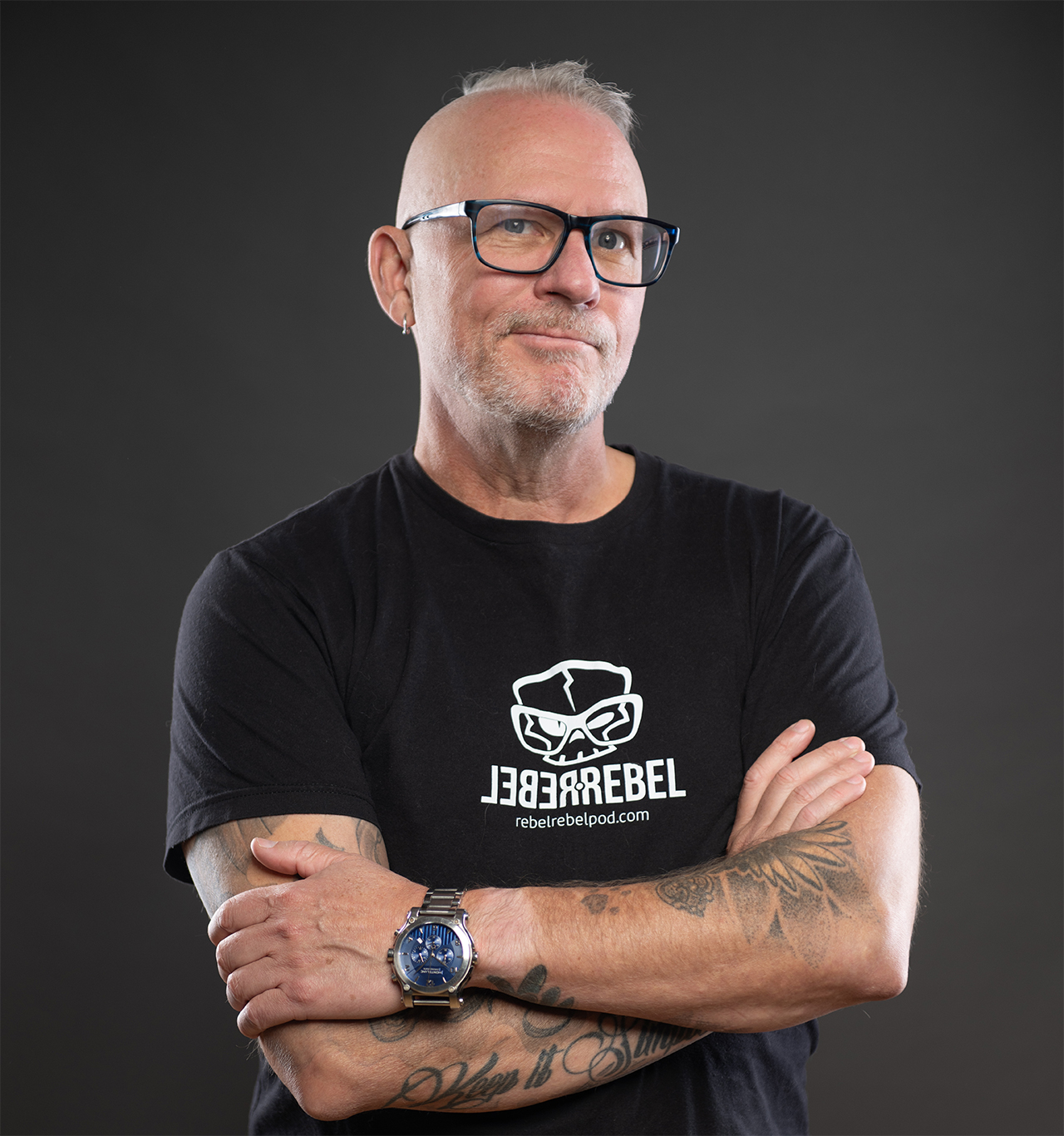
Michael Dargie is a creative strategist, entrepreneur, and the voice behind the RebelRebel Podcast. He founded Make More Creative, a creative agency helping brands stand out in a noisy world, and authored BrandJitsu™: Move Your Brand From 'Meh' To Memorable. A motorcycle rider, scuba diver, octopus whisperer, artist, writer, director, and adventurer — Michael brings a deep curiosity and genuine warmth to every conversation. He believes the best stories come from people who dare to do things differently, and he has spent nine seasons proving it.