Never Stop Running: Manuel Prinz on Chasing What Won't Leave Your Head

There's a moment in every good conversation where the guest says something and I have to resist the urge to just put down my coffee and stare at them for a while. Manuel Prinz gave me one of those moments, and it came out of nowhere.
We were talking about what scares him. And after mentioning rats (his words: "I scream like a little baby"), he paused and said something that actually landed: the thing that makes him genuinely anxious is having nothing to do. Sitting still. Vacation, specifically. He said his wife gives him two to three days to decompress before he's actually present.
"I'm like a shark," I said. "You gotta keep swimming."
He laughed and said yeah. Exactly that.
Manuel Prinz is a co-founder at Keep Converting, an AI e-commerce startup that's been in stealth mode and is now coming out into the open. He's lived in California for over sixteen years. He's visited somewhere north of a hundred countries. He grew up near Stuttgart, Germany, where the future was basically pre-packaged: go to school, become an engineer, work for Mercedes-Benz or Porsche or Bosch, and live a perfectly reasonable life.
He did not do that.
The Internship That Saved Him From the Wrong Life
Manuel was actually enthusiastic about the engineering route for a while. He wanted to work with cars. Stuttgart is basically the car capital of Europe, so the logic was there. His dad, sensing some impatience, pushed him into an internship first. Smart move, as it turns out.
The internship was hard labour. Screwing things together. Tools. Physical, repetitive, mechanical work. Manuel showed up expecting to find his calling and instead found his exit.
"I was like, wait, is that the engineering job I'm supposed to do?" he told me. "I was like, maybe that's not for me."
So he pivoted to business and economics at university. And somewhere buried in the fine print of his school's programme was a note about a student exchange with UC Santa Barbara. Nobody was advertising it. Nobody from his university was using it. It was just sitting there, hidden in the agenda like a secret door.
Manuel drilled down, found the contact, reached out to Santa Barbara, and basically willed the thing into existence. A semester in California. His first time in North America. His first time on a different continent entirely.
The Block in San Francisco That Changed Everything
He told me that stepping off the plane, the first thing that hit him was the cars. Big, polished SUVs everywhere. Coming from Germany, where that kind of vehicle was a luxury, he was genuinely stunned that this was just Tuesday for everybody.
But the moment that really stuck, the one that's still "branded in his head" as he put it, came during a weekend trip to San Francisco with his Santa Barbara roommates. They took him to the financial district. On one block, he saw an investment banker, a skateboarder, and a homeless person.
"How do these three worlds combine and exist in one block?" he said.
In Germany, he explained, everyone is more or less levelled. Same houses, same trajectory, same general economic bandwidth. Same middle class, same ceiling. San Francisco blew the ceiling off entirely. And what hit him hardest wasn't the wealth or the poverty. It was the individuality. Everyone on that block was their own person, chasing their own thing, building something, dreaming something specific.
"I want to be in that environment," he remembered thinking.
He never really left.
A Hundred Countries and a Chef Who Got Up at 4am
After his studies, Manuel joined a San Francisco tech startup called Paymentwall, essentially a Stripe for the early days of online business. Because every company with an internet presence was a potential customer, the travel mandate was enormous. Manuel ended up on the front lines of taking the company global.
Over a hundred countries, by his count. (He was appropriately sheepish about mentioning it, which I appreciated. Nobody wants to sit across from someone who brags about their passport stamps.)
I asked him to pick a favourite. He landed on Vietnam without much hesitation.
They had an office in Hanoi. Every morning, the team's local chef would wake up at four or five in the morning, walk to the market, buy fresh fish and herbs, and cook for the whole office. On Manuel's first day, the chef presented him with a fish soup at eight in the morning.
"It's 8am, fish soup," Manuel said. He could see the chef looking at him, deeply offended at the hesitation. So he tried it. And then asked for another serving.
"It was mind-blowing," he said. "So good."
He talked about the people in Vietnam with genuine admiration. Hardworking, determined, stubborn in the best possible way. He tried to negotiate with someone at a market and said the vendor almost followed him home. The price was the price. Respect.
His Two Moves in Every New City
After a hundred-plus countries, Manuel has refined his cultural immersion technique down to two moves. First: take the long cab ride. Don't skip it, don't optimize it. Use it. A taxi driver, he says, can give you a full, unfiltered briefing on a city in fifteen to twenty minutes. Invaluable.
Second: go to a local bar the first night. Don't go to the hotel restaurant. Go somewhere local, order something, and make contact with whoever's there. The cab driver fills in the frame. The bar fills in the texture.
It's such a simple system and I wish I'd thought of it years ago. (Though I did take a motorcycle sidecar thing with duct tape holding it together through the Philippines with my son, so I'm not exactly playing it safe over here either.)
The Thing That Doesn't Leave Your Head
Somewhere in the middle of our conversation, I asked Manuel about rebels in waiting. The people who have an idea, a pull toward something, a persistent thought that won't quit, but who haven't made the move yet. I think about these people a lot. I was one. Most of us were.
His answer was direct and I think it's worth sitting with.
"Every time you want to do something or you have some idea, that idea is in your head for a reason. If that thought persists, even when you sleep at night and it's still there, it's there for a reason."
He talked about the trap of talking yourself out of things. You start naming all the reasons it won't work. Then you tell other people, and they confirm the reasons it won't work. And suddenly you feel empowered not to do the thing. You've built a very convincing case for staying put.
"That's a trap a lot of people fall into," he said.
His mom used to tell him she stopped trying to talk him out of ideas entirely, because once he had one, it was pointless. Zero chance of success. He was already gone. But he was quick to say he wasn't always like that. It developed over time, through doing, through pushing through anyway, through running into walls and getting back up.
He's also not saying ignore all advice and yolo everything. He's saying that if the idea keeps coming back, if it's still there in the morning after you tried to logic it away the night before, then there's really only one way to find out. You go for it.
Never Stop Running
I asked Manuel if he had a personal motto, a star to navigate by. I shared mine (do cool and weird things with cool and weird people). He thought for a second and said his is: never stop running.
He meant it both literally and not. He said if he ever stops running, that's the end for him. The motion is the point. The keeping going is the thing. And it connects back to something he said earlier in our conversation, about what the world doesn't understand.
"The journey is the goal," he said. "There is no end state."
He talked about how he spent years chasing outcomes, thinking that once he hit a certain milestone he'd arrive somewhere worth arriving at. And then it never quite worked that way. The milestone arrived, and there was just another horizon.
What shifted for him was learning to actually want the in-between. To find something worth extracting from even the boring, repetitive, mundane days. Not to perform positivity about it, but to genuinely ask: what can I get from this? What's here that I can use?
He's building a startup now. Keep Converting. He's got kids. He splits his time between California and visits back to Germany. He wants to get to Australia. He wants to figure out how to spend more real time in both the old world and the new one, not just vacation visits but something that actually counts. He hasn't figured that part out yet, and he said so openly.
That honesty is part of what I liked about talking to him. He's not selling a destination. He's genuinely mid-run, figuring it out as he goes, and comfortable enough with that to say it out loud.
The Balut Thing
I'd be remiss not to mention that Manuel also ate a fertilized duck egg on a beach in Boracay, Philippines, at the enthusiastic insistence of a local vendor. His colleague nearly got sick watching. Manuel asked for the context, tried it anyway, and said it was good.
"You gotta try it, Mike. It was good. I felt great afterwards."
I said absolutely not. Some journeys have limits.
But that moment kind of sums him up, honestly. Someone offers you something unfamiliar, slightly alarming, and culturally loaded. The easy move is to politely decline. Manuel's move is to say yes and see what happens.
Turns out, usually, it's pretty good.
Catch the full conversation with Manuel Prinz on The RebelRebel Podcast and find out what else happens when you stop talking yourself out of things.
This article is based on
The Journey Is The Goal with Manuel PrinzAbout the Author: Michael Dargie
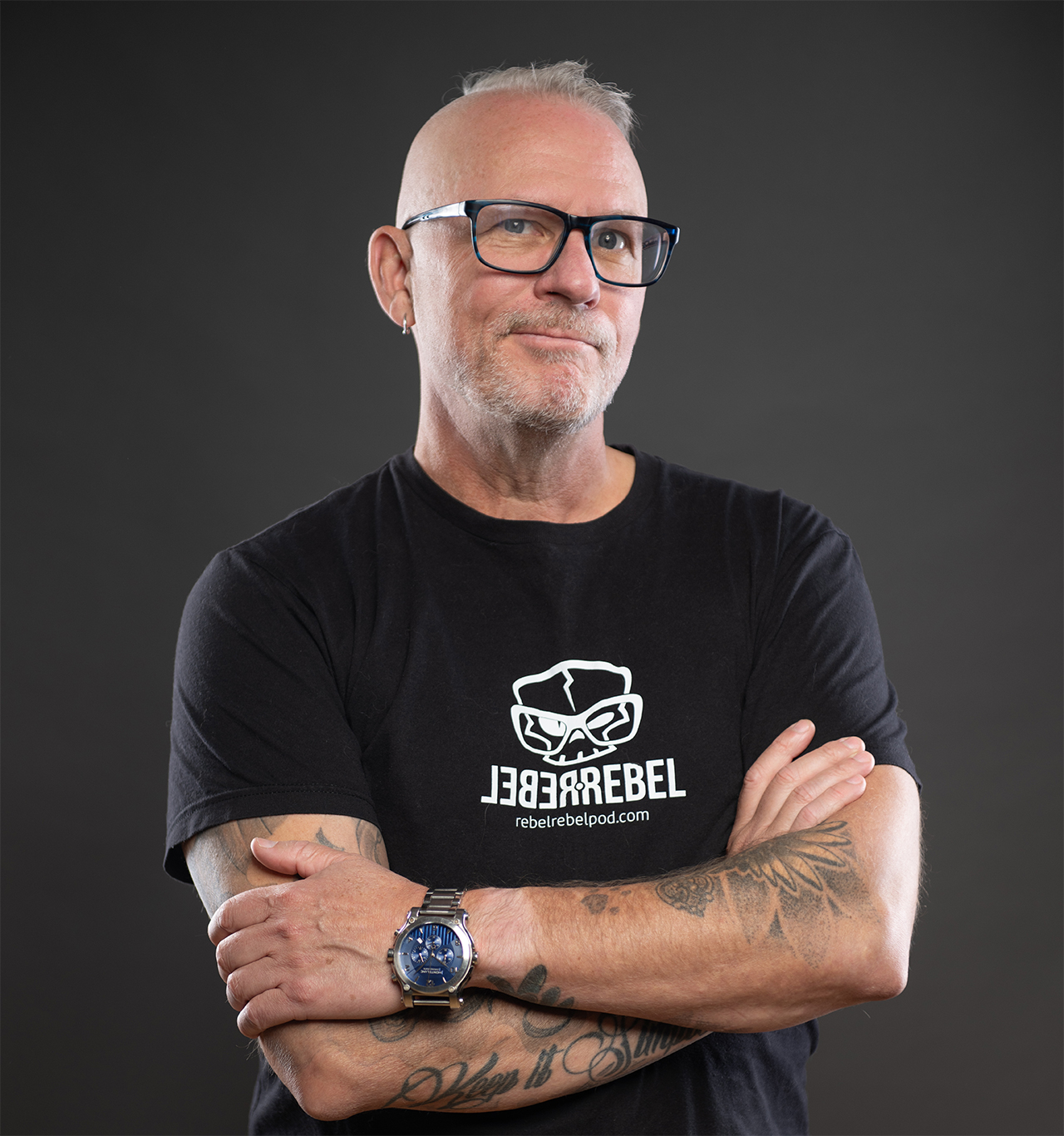
Michael Dargie is a creative strategist, entrepreneur, and the voice behind the RebelRebel Podcast. He founded Make More Creative, a creative agency helping brands stand out in a noisy world, and authored BrandJitsu™: Move Your Brand From 'Meh' To Memorable. A motorcycle rider, scuba diver, octopus whisperer, artist, writer, director, and adventurer — Michael brings a deep curiosity and genuine warmth to every conversation. He believes the best stories come from people who dare to do things differently, and he has spent nine seasons proving it.