Susie deVille: Chiseling Through the Concrete to Find Yourself

There's a version of hitting rock bottom where you lose one big thing and the story writes itself. Susie deVille lost three things at once. The real estate market cratered. Her marriage dissolved. Her health followed. All of it, at the same time, in what she calls her "nuclear winter."
Her first instinct was the same one most of us reach for. Work harder. Push through. Surely effort is the answer to everything.
It wasn't.
"All I did was end up deeper in the abyss of quicksand," she told me. And that's when she understood she wasn't going to grind her way out of this one. She was going to have to rebuild from something else entirely.
That something else turned out to be art.
The Concrete We Don't Know We're Wearing
Susie grew up in Highlands, North Carolina, a mountain resort town sitting at 4,118 feet. Her father was an engineer, artist, and entrepreneur. Her mother was a teacher with what Susie describes as an insane amount of intuition. And yet Susie spent most of her life convinced she hadn't inherited the creative gene.
"I was like, oh well, I didn't get any of the art genes," she said, laughing at the memory. "And that really speaks to how our cultural training shapes our thinking."
That cultural training is what she calls the concrete. The accumulated weight of what we've been told we are, what we're good at, what's realistic, what's practical. Left brain. Linear. Logical. She was exceptional at all of it. She studied anthropology, moved to Boston, worked in publishing, spent time at HarperCollins, travelled extensively, came home to Highlands, launched two nonprofit organizations from scratch (both still running today), and became a real estate broker.
She was, by any reasonable measure, successful. And underneath all of it, enormous chunks of her actual self were encased in cement.
The crack started in a master's programme classroom around 2005. A professor introduced her to IDEO, the legendary design firm out of Palo Alto, and something cracked open.
"The top of my head came off," she said. "And from literally that moment, all I wanted to do was learn about innovation and creativity."
When the nuclear winter arrived a couple of years later, that foundation was there to stand on. She started taking private lessons. Sketching. Watercolour. Abstract work with acrylics. Mixed media. Photography. And with each new form, more concrete fell away.
"What was left was the authentic me."
The Exhale We're All Addicted To
Here's the thing Susie said that landed hardest for me. She talked about inspiration not as a mood or a lucky feeling, but as a literal act. Breathing in. The inhale. And she pointed out that most of us have built entire lives around the exhale.
"We're great at the doing. We're great at burning out. We're great at the gerbil wheel. But we're horrible at play."
We skip vacations. We don't go into the woods. We don't do the things that bring us alive. And then we're baffled by the fact that we feel hollow. That our intuition has gone quiet. That the work feels mechanical and joyless.
Susie frames this as an energy problem, not a knowledge problem or a discipline problem. And that reframe is worth sitting with for a minute. When something isn't working, our culture's default answer is almost always "you need more information" or "you need to work harder." Susie says the actual answer is usually "you need more energy, and you've been depleting yours for years."
Bold action takes energy. Creative thinking takes energy. Hard conversations take energy. Holding a new boundary takes energy. And we're trying to do all of it running on empty.
"We routinely think the reason we're not getting success is because we don't know enough, we're not working hard enough," she said. "Back at Susie in nuclear winter, right?"
The 3 a.m. Discovery
So what does she actually do about it? This is where things get either inspiring or alarming, depending on your relationship with your alarm clock.
Susie woke up at five for years. Then, while writing her book and needing pages for her editor, she pushed it to four. And noticed something. At four, she could write beautifully. But at three, something else happened entirely.
"I could take dictation from the divine," she said. Not a metaphor she uses lightly. "It was coming, the channeling. It was crazy."
She'd been reading about deeply creative people who described almost mystical experiences between three and five in the morning. She tried it. It worked. She restructured her entire schedule around it, ramping down from screens and work early enough to sleep and wake fully rested at three.
(I want to be clear that I heard this, nodded thoughtfully, and will absolutely not be setting my alarm for 3 a.m. But I respect the commitment enormously.)
The point isn't the specific hour. Susie is quick to say that. She talks about what she calls your "creative circadian rhythm," the window when your clarity and focus and best thinking naturally show up. For her it's three in the morning. For some people it's five in the afternoon. The work is finding your window, not copying hers.
The Morning Practices Her Clients Fight Her On
Beyond the hour she wakes, Susie has built a morning ritual she advocates for in her book. Most of it feels intuitive. Some of it sounds almost too simple to matter. And one piece, she says, "all my clients fight me on."
Morning Pages
Three pages of longhand writing in a journal. Julia Cameron's famous tool. You're not writing anything important. You're draining the static out of your brain before the real day starts. Just get the junk out onto paper.
Movement
Get outside. Walk. Swim. Pilates. Whatever it is, move the body. This is not a productivity hack. It's just basic maintenance for the machine.
Meditation and Inspired Learning
For Susie, this looks like poetry. Or a passage from a book. Or her favourite: finding an inspirational quote and recording it in a five-year journal. That running archive of what she calls "wonderful juju from brilliant minds throughout time" has become, unexpectedly, one of her most generative creative sources. The quotes talk to each other. They talk to her. Every time she opens that book, there's a new ignition cycle.
Make Something
This is the one that gets the pushback. Make something with your hands. A quick sketch. A collage. A French sauce. It doesn't matter what. Just cross the threshold from the digital world into the analog one.
"Even five minutes," she said. "You lose your identity there. What happens when you're not at the wheel and the soul gets to have a chance at the mic, your thoughts change, your central nervous system recalibrates, your creativity is just completely fired up."
Five minutes of morning pages. Five minutes making something. That's the minimum viable dose, and she swears it's enough to change the trajectory of your entire day.
The Flaneur Philosophy
Susie travels to Paris a couple of times a year, and she described it with the kind of specific, sensory detail that makes you reach for your credit card. She mentioned a dish at Le Procope, the oldest café in Paris, in the sixth arrondissement. Beef cheeks in a sublime sauce, topped with rigatoni and melted parmesan, served in a copper pot, brought to the table by a team of immaculately turned-out waitstaff.
The first time she tasted it, her eyes rolled back, she leaned into the banquette, and the entire waitstaff circled around and gave her a round of applause.
"That's what being in France is so fabulous," she said. "They love it when you love what they have made."
But the reason she keeps going back to Paris isn't just the food. It's a concept she described using the French word flâneur. Classically it means to stroll, but Susie uses it to mean something closer to "getting lost on purpose." Letting go of the itinerary. Surrendering the map. Letting serendipity have a chance.
She connects this directly to her work. The ability to surrender into a moment when it's not all planned out is the same muscle you need as an entrepreneur. Tolerating uncertainty. Staying curious when you don't know what comes next. It's not just a travel philosophy. It's training for being a more alive human being.
The Concrete Chiseler in Chief
Susie calls herself the Concrete Chiseler in Chief, and she means it literally. She takes her anthropology background and uses it to lead people on what she describes as "an archaeological dig of the self." Entrepreneurs and creatives who are burned out, stuck, whose income has plateaued, whose lives have gone grey and flat.
The work is reconnecting people to their innate creativity. But it doesn't stop at the personal. She pairs that inner work with actual business strategy. Getting your energy back is the launchpad, not the destination.
She described it with a metaphor I really liked. "That's the time we leave the pier and we get to go on that grand voyage. But we're not even going to feel like getting up and putting the sneakers on to walk down to the pier, because we're completely burned out."
And to the rebels just starting out, or the ones partway through and wondering how they're going to get to the next step, she had this to say: "What you are embarking on is more about the dragon that you're going to meet in the individual caves that you enter. It's your ability to tolerate uncertainty and still take action and still keep getting up and still keep trying and still keep failing and still walk around on your hands and knees in the dark."
Congratulations on your bravery, she said. Then: hang in there. And let yourself enjoy the fun and the magic and the mystery of it.
That's not a small thing to offer someone. Coming from a person who once found herself on, as she put it, "multiple gurneys" during her nuclear winter, it carries weight.
What I'm Taking Away
I've been thinking about the exhale thing ever since we talked. About how easy it is to be brilliant at the output and completely neglectful of the input. Most of us treat inspiration like a bonus, something that shows up if we're lucky, not something we're responsible for engineering daily.
Susie treats it like a practice. Like a discipline. Which is a bit of a paradox, building a disciplined practice around the very thing that's supposed to be loose and spontaneous. But that's the point. You don't wait for inspiration. You create the conditions for it. Then you get out of the way.
I'm probably not waking up at 3 a.m. But I might dig out the sketchbook. And I'm definitely booking a flight to Paris.
Catch the full conversation with Susie deVille on The RebelRebel Podcast and hear her talk about creative circadian rhythms, nuclear winters, and beef cheeks in copper pots.
This article is based on
Find Your Fire Again with Susie deVilleAbout the Author: Michael Dargie
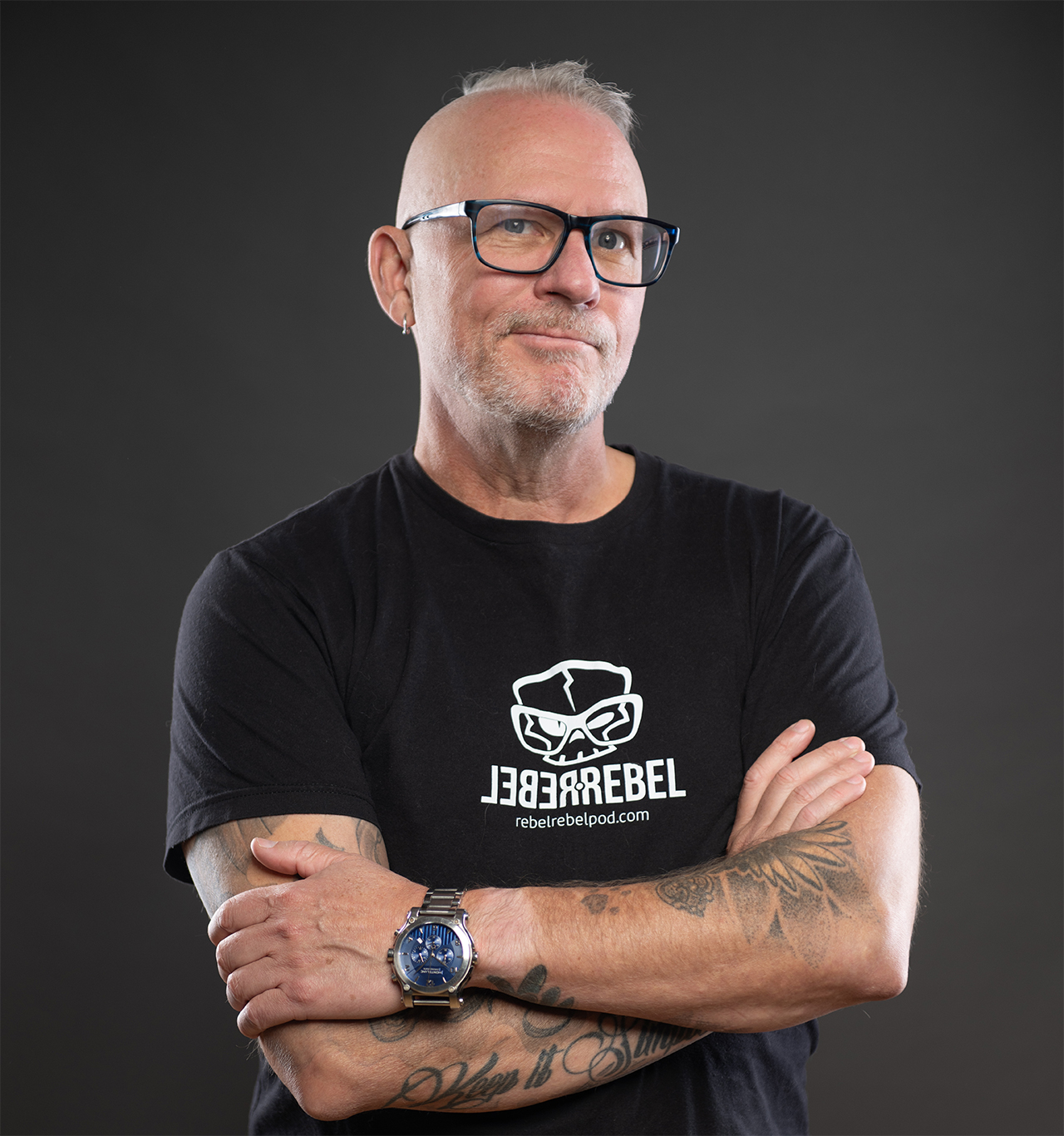
Michael Dargie is a creative strategist, entrepreneur, and the voice behind the RebelRebel Podcast. He founded Make More Creative, a creative agency helping brands stand out in a noisy world, and authored BrandJitsu™: Move Your Brand From 'Meh' To Memorable. A motorcycle rider, scuba diver, octopus whisperer, artist, writer, director, and adventurer — Michael brings a deep curiosity and genuine warmth to every conversation. He believes the best stories come from people who dare to do things differently, and he has spent nine seasons proving it.