Corey Croft on Writing as Therapy, Ego Death, and Staying Weird

There's a bench in Vancouver's West End. It sits about 500 metres from the water, and on a summer evening it catches this particular beam of orange light that makes everything go soft and fuzzy. Corey Croft walks to that bench, coffee in hand, book in one pocket, cigarettes in the other. If someone's already sitting there, he just loops the block and tries again.
I love that. There's something about a person who has a bench with a specific beam of light as their destination that tells you everything you need to know about who they are.
Corey is a Vancouver-based author and indie publisher, the one-man operation behind Fly Pelican Press. His new novella, France Versus Brazil 98, comes out January 20th. He describes it as literary fiction with an existential slant. Somewhere in the vicinity of Camus and Sartre, pondering existence, finding meaning, driving purpose. It's not exactly beach reading. Which is probably why I liked him immediately.
The Thousand Words That Changed Everything
Corey didn't sit down one day and decide to become a writer. It happened the way most important things happen: sideways, while he was looking at something else.
He was in a rough patch. Depression and anxiety doing their usual thing. His girlfriend at the time gently suggested he go talk to someone. He went to a therapist, realized they were going to ask him about his childhood, and thought, "I don't admire the problem now. So what is that going to do?"
Fair assessment, honestly.
Then he spotted something on a community bulletin board. A challenge. A thousand words a day for a month. Not NaNoWriMo. Just a handwritten note with a couple tacks holding it to a board in the hallway of some community centre. He says he was letting his eyes go like one of those old 3D pictures, just wandering, when it caught him.
He sat down to write. Had nothing. Sat there anyway. And then the words started coming, and they kept coming, and somewhere in that mess of hundreds, then thousands of words, he started to notice that he wasn't just venting. He was building something. Wrapping a narrative around the difficult stuff, cocooning it, and then watching something else come out the other side.
"Writing became therapy," he said, simply. And then, not so simply: "I know I can feel the differences in my personality, in my day to day life. The kind of person I am, the man that I've become, I owe exclusively to digging inside the difficult parts."
There's a pumice stone metaphor in there too, rubbing up against the traumatic moments until they smooth out into something you can learn from. I didn't want to interrupt him when he said it. That's the kind of thing you just let sit for a second.
Dostoyevsky on a Megabus
When I asked Corey about the author who got him into writing, properly into it, the one who lit the actual fuse, he didn't hesitate. Dostoyevsky. Crime and Punishment. Read on a Megabus from Montreal to Toronto.
Not a library. Not a coffee shop with good light. A Megabus. Which, if you've ever been on one, is arguably the least romantic reading environment imaginable. And yet.
He said it was the moment he stopped looking at things and let them permeate into him. Touch his heart. That's a specific kind of shift, the difference between consuming something and being changed by it. A lot of people read Crime and Punishment. Not all of them feel it on a bus between two Canadian cities.
On the Ego, and Why It Should Die on the Vine
I asked Corey what he'd tell aspiring writers. He didn't say "write what you know" or "read a lot." He said: leave the ego at the door. Let it shrivel up and die on the vine. Get swept away on someone's shoulders as they pass by.
His words, not mine. Which is exactly why Corey Croft is interesting to talk to.
He made a distinction that I think gets lost a lot. You need self-belief. You need to think your stories are worth telling. But ego, the part that expects overnight success, that gets precious about ideas too small to pursue, that inflates your timeline and your sense of arrival, that part doesn't serve you. It just gets in the way.
He also said something I keep turning over: "You always have time. You just have to make it." He figured that out while digesting lunch on his couch, watching YouTube. Which is, in its own way, a profound place to have a revelation.
(The number of people I've met who say they'd write a book "when they have time" could fill several buses. Possibly several Megabuses.)
His actual writing practice looks like a job. Stephen King's On Writing made an impression on him, and he took the lesson to heart. On days he's working nights, he gets up, trains, comes home, showers, puts on proper pants, and writes. Writing pants. Lunch break and everything. On days off, it's a full eight-hour stretch. He said by nightfall he has about the same attention span as a jellyfish, which I found both relatable and a very elegant way to describe the feeling of 6 PM on a creative day.
What He Hates in Other People's Writing
Corey is diplomatic about most things. About writing tropes, he is less so.
He can't stand when female characters are introduced through a description of their physical beauty first. The blond bombshell entrance. The "all eyes in the room" moment. He's not precious about it, he just finds it lazy, and he thinks a lot of male writers, himself included, shouldn't try to write female leads if they can't get past that instinct. He'd rather leave the character's specifics open, let the reader fill them in, than hand over a cardboard cutout and call it a character.
He also mentioned a conversation with a friend who pointed out how often Black characters in fiction are described through food metaphors. Chocolate, caramel, that whole lexicon. His friend put it plainly: why are we always flavours? Corey didn't dress that up or over-explain it. He just let it land.
The other thing he talked about was over-description. His mom reads all his work and she called him out on it early. Every sense firing at once, taste and touch and smell all competing for attention. She told him he didn't need all of it. Pick one or two. Let a single detail do the work of five. He listened. Now he thinks about which sense tells the most in the least, and he picks that one.
"Show, don't tell," he said. But also, sometimes just tell. If you've got the style and the confidence to pull it off, say it straight. Don't make your readers count chattering teeth for three pages when you could just say it's cold.
Freaks, Pods, and the Homogenous World
I asked Corey, on one of those walks to his bench, what's the one thing sitting in his head that he wishes people knew.
He took his time with it. And then he talked about The Matrix. Specifically, the pods. How his parents' generation would have said "I'm not getting in a pod, are you stupid?" And how each generation after that has moved a little closer to just climbing in. The quick answer to the hard question. The trusted source that lets you skip taking on blame. The easy solution that requires you to hand over your weirdness, your defects, your specificity, in exchange for comfort and frictionlessness.
What worries him is homogeneity. That we're sanding off the edges of people. That the things that make someone strange and specific and worth knowing are exactly the things the algorithm quietly punishes.
"The freaks make up the world," he said. "Without them it would just be like Stepford Wives. Everybody mowing their lawn at the same time in the same direction."
Every person he loves, he said, has defects. And those defects are precisely why he loves them. They're weird and absurd and imperfect and that's the connective tissue. You can't connect with each other through a harsh winter if you've all been optimized into the same shape.
The Stories Still in His Head
The anxiety and depression are still there. He's clear about that. A bear trap around his ankle, he called it. He's not pretending he's fixed or healed or that writing solved it. But he's written eight books in a series (only one released so far, with two more to come), and the desire to get the remaining stories out is what pulls him forward on the hard days.
Not out of some sense of cosmic duty, he was careful to say. Not like a mujahedeen trying to get ideas into the world. Just because it's fascinating and challenging and fun, and because it's the connective tissue between him and everything else. To stop creating would be to watch the world float away like a leaf on a lake.
He said maybe one day things will feel normal. Then he immediately said, well, that sounds boring.
Yeah. It does.
The Terrible Book He Can't Stop Reading
I asked Corey the weirdest thing about himself he'd be willing to share. He thought for a moment and landed on this: he cannot stop reading a book once he's started it. Cannot. Even if it's genuinely terrible. Even if someone traces the blade across his neck.
At the time of our conversation, he was racing through a Henry Miller collection of short stories he'd bought in Edinburgh for two pounds. Paid for by a pornographer, written to be depraved. Which in theory sounds interesting. In practice, he said, it reads like a very eloquent high school student boasting while chewing gum with his hat on backwards.
He was scheduling two reading sessions a day just to get through it faster.
I love him for that. The commitment. The refusal to abandon ship even when the ship is clearly going nowhere good. There's probably a metaphor in there about creativity and persistence, but Corey would probably tell me to just say what I mean and stop describing the sconces.
What to Do Before You Go into the Jungle
When I asked him what to tell the Rebels In Waiting, the people on the edge of starting something, he circled back to the same idea he'd been orbiting all conversation. Keep the passion at the centre. Keep the art flying the flag. Let what you love fully take you over, drown you a little, and trust the clarity that comes from that.
Don't worry about whether you're ready for rejection and failure. You're not. Nobody is. But asking that question before you go in is like looking for guarantees before you step into a jungle. Part of the point is that you go in without a machete and figure it out.
You might come back a completely different person. That's the whole idea.
Corey Croft came back from his jungle a novelist, a publisher, and someone who has a very specific bench with a very specific beam of light, and knows exactly what to do if it's taken when he gets there. That's not nothing. That's actually quite a lot.
Catch the full conversation with Corey Croft on The Rebel Rebel Podcast and find his books at coreycroftauthor.com.
This article is based on
Writing Through The Darkness with Corey CroftAbout the Author: Michael Dargie
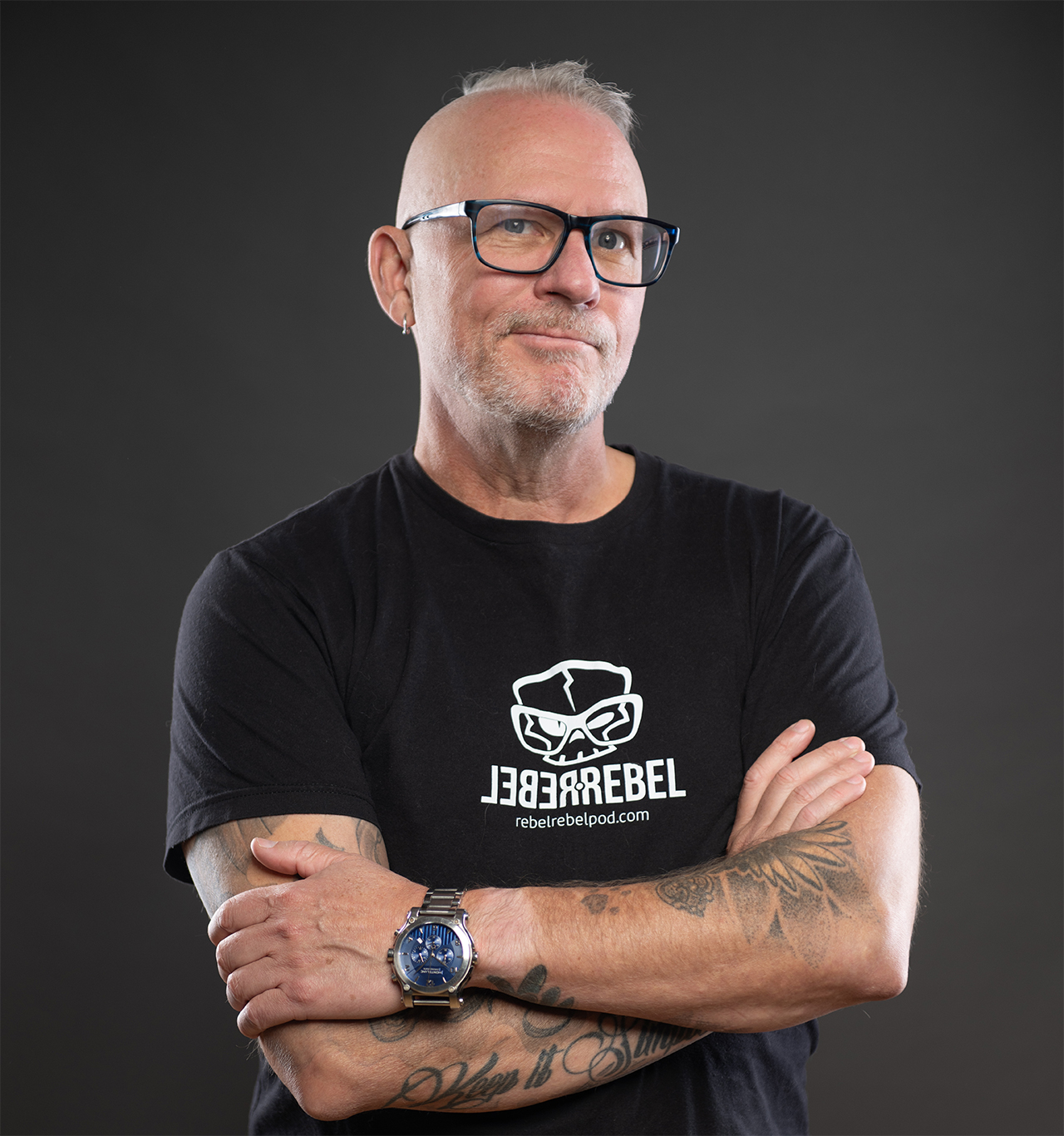
Michael Dargie is a creative strategist, entrepreneur, and the voice behind the RebelRebel Podcast. He founded Make More Creative, a creative agency helping brands stand out in a noisy world, and authored BrandJitsu™: Move Your Brand From 'Meh' To Memorable. A motorcycle rider, scuba diver, octopus whisperer, artist, writer, director, and adventurer — Michael brings a deep curiosity and genuine warmth to every conversation. He believes the best stories come from people who dare to do things differently, and he has spent nine seasons proving it.