Rebel Spotlight: Susie deVille, Creativity Coach
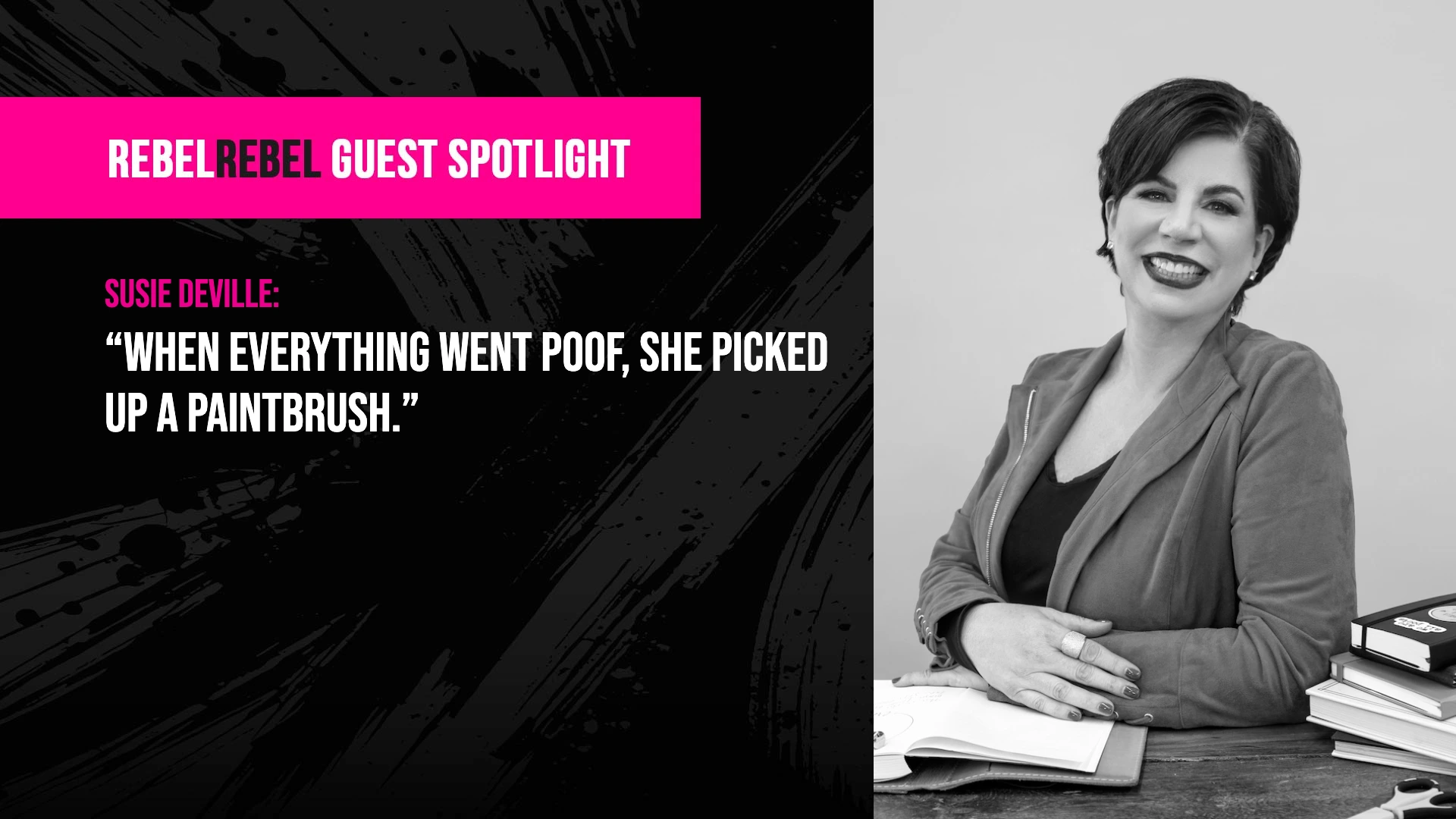
She called herself the Concrete Chiseler in Chief, and I knew immediately that this was going to be a good conversation.
Susie deVille has had a life that reads like four different people's lives stitched together. Publishing executive. Nonprofit founder. Real estate broker. Artist. Creativity coach. Author. Early morning mystic who wakes at three a.m. to, in her words, "take dictation from the divine." And somehow it all makes complete sense when you hear her tell it.
She joined me from Highlands, North Carolina. Four thousand, one hundred and eighteen feet above sea level, in case you were wondering. She was specific about that number. I appreciated it.
The Nuclear Winter
Here's the part that stops you in your tracks. Around 2008, everything fell apart at once. The real estate market cratered. Her then-husband was a contractor. The household finances went, as she put it, "poof." Then the marriage went poof. Then her health started going poof too.
Her instinct, like most of ours, was to work harder. Put your head down. Grind through it. Push.
"All I did was sort of end up deeper in the abyss of quicksand," she told me. "That's when I realized I was going to have to change my entire way of living and being."
She called this period her nuclear winter. Not with bitterness. With a kind of clear-eyed honesty that only comes from having actually survived something. The thing that pulled her through wasn't a strategy or a productivity system. It was a class she'd taken a few years earlier, during her master's degree, where she was introduced to the design firm IDEO out of Palo Alto.
"The top of my head came off," she said.
That moment planted a seed. And when everything else burned down, that seed was what she had left to stand on.
The Paintbrush as Power Tool
Susie grew up in a household with an engineer-artist-entrepreneur father and a wildly intuitive teacher mother. And somehow, despite all of that creative genetics floating around, she decided early on that she wasn't an artist. That the art genes had simply skipped her.
(This is, she will tell you in about thirty seconds flat, completely and categorically false. She says she can prove to anyone, in three minutes and with a single piece of paper, that they are an artist. I believe her.)
During her nuclear winter, she started taking private lessons. Sketching. Watercolour. Abstract acrylics. Mixed media. Photography. And something began to shift.
"What felt like giant chunks of concrete were just kind of cracking and fissuring and falling away," she said. "And what was left was the authentic me."
That image, the concrete, became her whole framework. She's not a coach who helps you optimize your morning routine or nail your LinkedIn profile. She's in the business of chiselling away the calcified layers that accumulate over years of doing what you're supposed to do instead of what you're actually made for.
Who She Helps and How
Susie now works with entrepreneurs, creators, and visionary leaders who are stuck. Burned out. Capped on income. Or, as she describes it, people from whom "all the colour has drained out of life."
Her approach is part creativity coaching, part anthropological excavation of the self. She takes people on what she calls an archaeological dig, using art-making, morning practices, and a pretty rigorous framework to pull people out of the quicksand and back into their own aliveness.
The distinction she draws that I found most useful is the one between time management and energy management. We're obsessed, culturally, with productivity. With optimizing time. But energy, she argues, is the thing we're actually running low on, and it's the thing nobody teaches us to replenish.
"Any kind of bold action takes a lot of energy. Creating, innovating, having a hard conversation, holding a new boundary. Lots and lots of energy. And we are routinely exhausted and depleted."
Her word for the solution is inspiration. Not the Instagram-quote kind. The literal kind. From the Latin inspirare. To breathe in. She talks about Paolo Coelho's framing of it: breathing in what brings you alive, not just perpetually exhaling into the grind.
The Morning That Starts at 3 a.m.
Susie developed what she calls a creative circadian rhythm. The idea is that just like your biological clock has a peak period for rest and alertness, your creative brain has its own window. You just have to find it.
Hers, it turns out, opens at three in the morning. She discovered this while writing her book, chasing an earlier and earlier start time to beat her deadline, and noticing that the earlier she got up, the better the writing got. By three a.m., she described it as being able to channel something almost beyond herself. The words just came.
She reorganized her entire life around that window. She stops work early, ramps down from screens, sleeps, and rises in the dark to write.
Her morning practice includes Julia Cameron's morning pages (three handwritten pages of whatever is in your brain), movement of some kind, meditation, a moment of inspired learning like poetry or a meaningful passage, and, most controversially, making something with your hands. A quick sketch. A collage. A vat of gumbo. Whatever it is, it has to be analog.
"When the soul gets to have a chance at the mic, your thoughts change, your central nervous system recalibrates, your creativity is completely fired up."
She told me her clients fight her on the making-something one every single time. And then they do it, and they stop fighting.
The Flaneur and the Beef Cheeks
You can't talk to Susie deVille for long without ending up in Paris. She goes a couple of times a year, has since she was twenty-one years old and stepped off a plane and somehow just knew how to navigate the city. She describes it as feeling immediately at home in a place she'd never been.
She uses the French word flâneur to describe her ideal mode of travel. To stroll. To get lost on purpose. To put down the itinerary and let serendipity take the wheel.
And then she told me about the beef cheeks at Le Procope, the oldest café in Paris, in the sixth arrondissement. A copper pot. A braised, falling-apart beef cheek in a sublime sauce. Rigatoni. Melted Parmesan. She described taking her first bite and her eyes rolling back in her head and leaning into the banquette in pure ecstasy. The entire wait staff circled around her and gave her a round of applause.
I mean. Come on.
That story, more than anything, tells you who Susie deVille is. She's someone who shows up fully. Who lets herself be moved. Who doesn't perform delight, she just has it, openly, in front of strangers in a Parisian brasserie at nine in the morning after a transatlantic flight.
The Advice She Gives Rebels in Waiting
When I asked her what she'd say to someone just starting their own rebellion, she led with congratulations. For the bravery. Then she got real.
"It's more about the Joseph Campbell-esque dragon you're going to meet in the individual caves you enter," she said. "It's your ability to tolerate uncertainty and still take action and still keep getting up and still keep trying and still keep failing and still walk around on your hands and knees in the dark."
That's the work. Not the launch plan. Not the marketing funnel. The tolerance of uncertainty. The willingness to keep moving when you can't see where you're going.
She told people to keep a journal. To track the dig as they go. To create what she called a nautical chart, recrafted every morning, pointing toward "the islands of your highest and best desires."
And to surround yourself with people who are also going for it. Because collective momentum is real, and you're going to need it.
Susie deVille is at innovationandcreativityinstitute.com, where she has a free toolkit for anyone currently signalling SOS.
Catch the full conversation with Susie deVille on The RebelRebel Podcast. It's the one where I ended the call genuinely considering booking a flight to Paris and waking up at three in the morning. She has that effect on people.
This article is based on
Find Your Fire Again with Susie deVilleAbout the Author: Michael Dargie
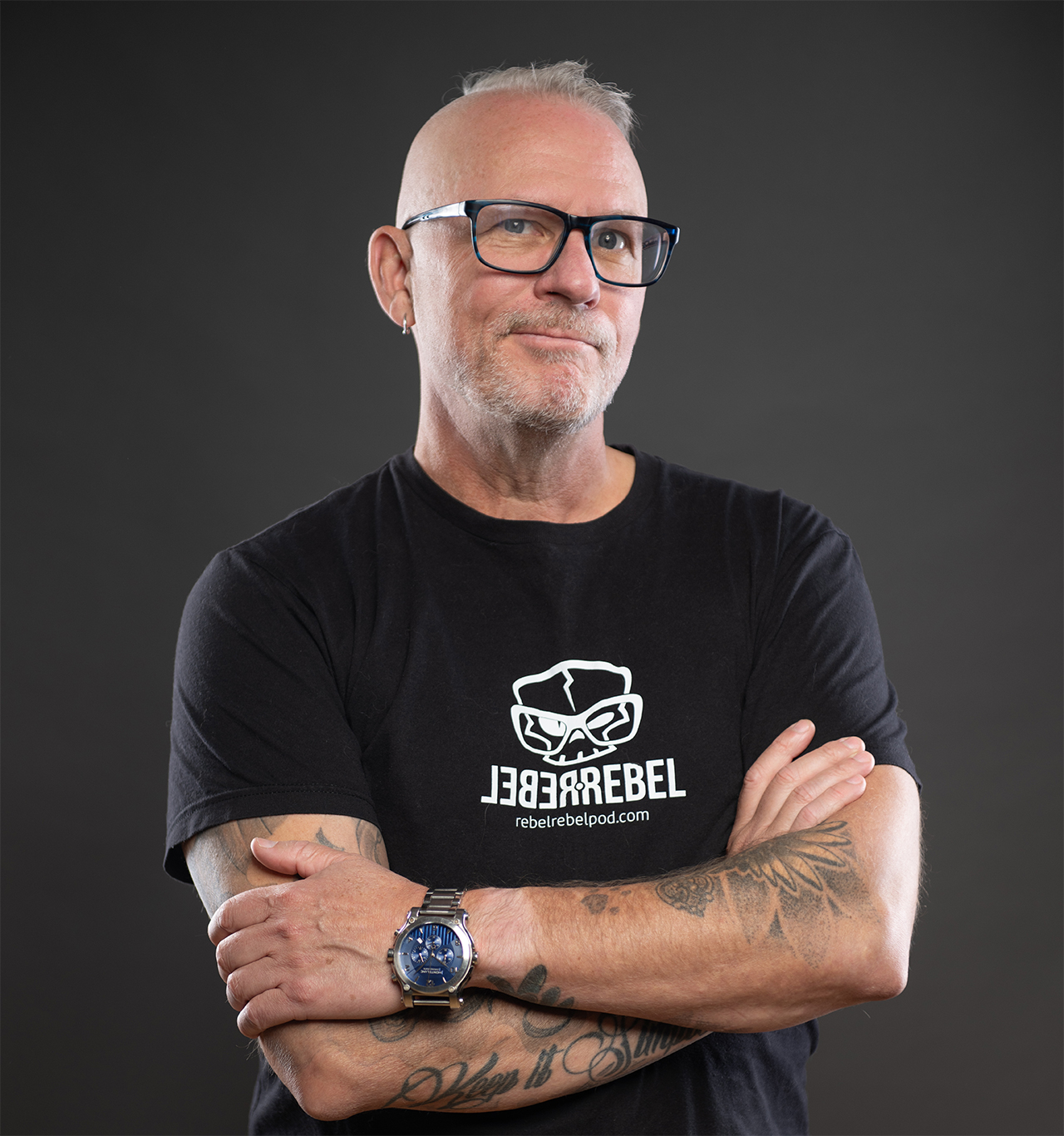
Michael Dargie is a creative strategist, entrepreneur, and the voice behind the RebelRebel Podcast. He founded Make More Creative, a creative agency helping brands stand out in a noisy world, and authored BrandJitsu™: Move Your Brand From 'Meh' To Memorable. A motorcycle rider, scuba diver, octopus whisperer, artist, writer, director, and adventurer — Michael brings a deep curiosity and genuine warmth to every conversation. He believes the best stories come from people who dare to do things differently, and he has spent nine seasons proving it.